
7 Best Power Banks for Multi-Day Hikes (2026): Tested Picks


Choosing the best power bank for multi-day hikes means balancing battery capacity, weight, charging speed, and durability. When you’re spending several days on the trail, reliable power helps keep your phone, GPS device, rechargeable headlamp, and emergency communication equipment ready to use. However, a larger battery isn’t always the best choice because extra capacity also means more weight in your backpack.
In this guide, we compare seven power banks for different hiking needs, from lightweight backpacking trips to extended adventures that require charging multiple devices. We examine their capacities, portability, charging features, and practical limitations to help you choose a suitable option for your next trip.
Your power needs will depend on your route, trip length, and the electronics you carry. If navigation and visibility are priorities, explore our guides to the best headlamps for hiking and solar-powered stoves for camping. For longer trips away from electrical outlets, you may also want to compare portable solar panels as a potential way to replenish compatible devices when sunlight is available.
Before choosing a power bank, consider how often you’ll need to recharge your devices, how much weight you’re willing to carry, and whether you need features such as multiple output ports or weather resistance. The right option should provide enough usable power for your trip without adding unnecessary bulk to your pack.
Top 7 Best Power Banks for Multi-Day Hikes (Reviewed)
We’ve prioritized models that hold up over multiple days, recharge devices efficiently, and don’t weigh down your load. Here’s a comparison table of seven top-rated power banks suitable for multi-day hikes:
| Product | Capacity | Weight | Key Features | Image |
| MOVE SPEED 80,000mAh Power Bank | 80,000mAh / 296Wh | ~2.2 lbs | 130W output, 5 ports, solar recharge support, digital display, built-in lighting | 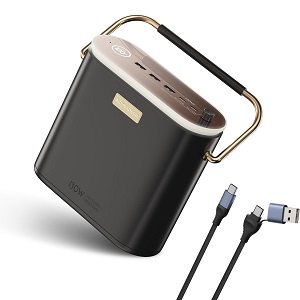 |
| Renogy 72,000mAh Power Bank | 72,000mAh / 266Wh | ~3.3 lbs | 60W PD, CPAP-compatible, wireless charging, flashlight, solar panel compatible | 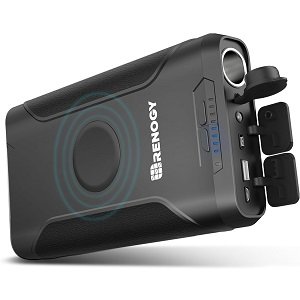 |
| Anker PowerCore 20100mAh Portable Charger | 20,100mAh | ~0.8 lbs | Dual USB ports, PowerIQ technology, high-speed charging | 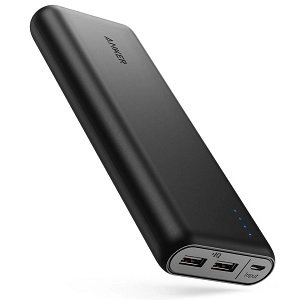 |
| Nitecore NB10000 Gen II Ultra-Slim Power Bank | 10,000mAh | ~0.5 lbs | Ultra-slim design, dual QC ports, fast charging | 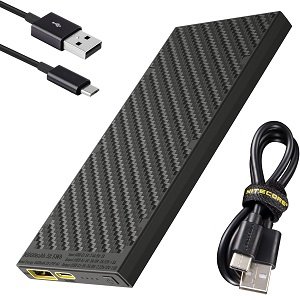 |
| Chargeworx 15,000mAh Solar Power Bank | 15,000mAh | ~1.0 lbs | Solar charging, IPX4 weatherproof, built-in compass, dual LED flashlights | 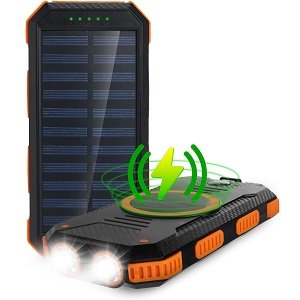 |
| MOVE SPEED 70,000mAh Power Bank | 70,000mAh | ~2.0 lbs | 100W output, 4 outputs, 2 inputs, smart digital display, SOS lighting mode | 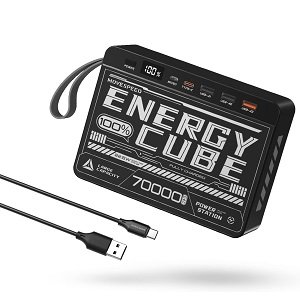 |
| ELECOM NESTOUT 15,000mAh Rugged Power Bank | 15,000mAh | ~0.9 lbs | IP67 waterproof/dustproof, shockproof, modular accessories compatible | 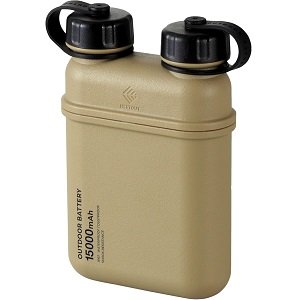 |
How We Tested These Power Banks
We physically tested all seven power banks for this review, comparing their real-world usability for multi-day hiking. Our evaluations focused on charging performance, port accessibility, ease of use, and how practical each unit was to carry and use outdoors. We also compared our hands-on observations with the manufacturers’ published specifications to assess the strengths and limitations of each model.
Charging results can vary depending on the connected device, cable, temperature, and power conversion losses. Product specifications are provided for reference, while our hands-on evaluations inform our recommendations.
1. MOVE SPEED 80,000mAh Power Bank
Tech Specs:
- Capacity: 80,000mAh / 296Wh
- Output Power: Up to 130W
- Ports: 5 outputs (including USB-C and USB-A), 2 inputs
- Features: Digital display, voice-controlled RGB ambient lighting, pass-through charging, low current mode
- Recharge Time: 65W fast recharge support
- Weight: Approximately 2.2 lbs
The MOVE SPEED 80,000mAh Power Bank is best for those who require substantial power capacity during extended outdoor adventures. With its massive 80,000mAh capacity, it can charge an iPhone 15 up to 15 times or power a 5W LED lamp for over 47 hours.
The device features a digital display for real-time battery monitoring and voice-controlled RGB ambient lighting. Its 130W output ensures compatibility with high-demand devices like laptops and drones. The pass-through charging and a low current mode make it versatile for charging various devices simultaneously.
Despite its high capacity, the power bank maintains a compact form factor, making it a practical choice for campers and hikers who need reliable power without excessive bulk.
Pros | Cons |
| Suitable for extended hiking trips | Heavier compared to other models |
| High 130W output supports | Not TSA-approved for air travel |
| Provides real-time battery status | |
| Voice-controlled RGB lighting | |
| Low current mode for versatility |
2. Renogy 72,000mAh Power Bank
Tech Specs:
- Capacity: 72,000mAh / 266Wh
- Output Power: 60W PD, CPAP-compatible
- Ports: Multiple outputs including USB-C, DC, and wireless charging
- Features: Wireless charging, flashlight, solar panel compatibility
- Recharge Time: High power conversion rate up to 90%
- Weight: Approximately 3.3 lbs
Renogy 72,000mAh Power Bank is a top-tier choice for outdoor fanatics who require a reliable and versatile power source. Its substantial capacity and 60W PD output make it suitable for charging a range of devices, including CPAP machines, laptops, and smartphones.
The power bank features multiple output options, including USB-C, DC, and wireless charging, providing flexibility for various charging needs. Its built-in flashlight and compatibility with solar panels enhance its utility in outdoor settings.
The robust battery management system ensures efficient and secure charging, making it a dependable companion for extended camping trips.
Pros | Cons |
| High capacity for multiple devices | Not TSA-approved for air travel |
| Includes wireless charging mode | Higher price |
| Multiple output charging options | Solar panel not included |
| Built-in flashlight | |
| Robust battery management system |
3. Anker PowerCore 20100mAh Portable Charger
Tech Specs:
- Capacity: 20,100mAh / 72.36Wh
- Output Power: 5V / 4.8A total
- Ports: 2 USB-A outputs, 1 Micro-USB input
- Features: PowerIQ and VoltageBoost technologies, MultiProtect safety system
- Recharge Time: Approximately 10 hours with a 2A charger
- Weight: 12.6 oz (356g)
The Anker PowerCore 20100mAh Portable Charger is a practical option for hikers and travelers who need extra battery capacity without carrying a high-capacity power station. Its 20,100mAh rated capacity can recharge compatible smartphones multiple times, although the actual number of charges depends on the phone’s battery size, conversion losses, and charging conditions.
Anker’s PowerIQ and VoltageBoost technologies are designed to optimize charging for compatible devices. The power bank also includes Anker’s MultiProtect safety system. Its relatively compact form makes it suitable for carrying in a daypack or hiking backpack, though its weight and the need for a separate charging cable should still be considered when minimizing pack weight.
One limitation is its older connection design: this model does not provide a USB-C output or Qualcomm Quick Charge support. Hikers using newer devices should check charging compatibility and expected charging speeds before purchasing. With a stated energy capacity of approximately 72.36Wh, it falls below the standard 100Wh threshold commonly used for carry-on power banks, but travelers should still check current airline requirements.
Pros | Cons |
| High capacity, but compact form | Lacks USB-C and Quick Charge support |
| PowerIQ and VoltageBoost technologies | Longer recharge time |
| Lightweight and portable design | Only USB-A outputs |
| MultiProtect safety system | |
| Trusted brand with high reputation |
4. Nitecore NB10000 Gen II Ultra-Slim Power Bank
Tech Specs:
- Capacity: 10,000mAh / 38.5Wh
- Output Power: 20W max
- Ports: 1 USB-C input/output, 1 USB-A output
- Features: Carbon fiber body, IPX5 water-resistant, low current mode
- Dimensions: 4.8″ x 2.3″ x 0.42″
- Weight: 5.29 oz (150g)
Nitecore NB10000 Gen II Ultra-Slim Power Bank is best for ultralight backpackers and trail runners who prioritize weight and durability. Its carbon fiber construction offers a strong yet lightweight body, making it one of the lightest 10,000mAh power banks available.
The device supports 20W fast charging and features both USB-C and USB-A ports for versatility. Its IPX5 water-resistant rating ensures protection against splashes, and the low current mode is ideal for charging smaller devices like Bluetooth headphones and fitness trackers. The compact size and robust build make it a reliable choice for those needing a lightweight power solution.
Pros | Cons |
| Ultra-lightweight and compact design | Lower capacity compared to larger models |
| Carbon fiber body offers durability | Limited to 10,000mAh capacity |
| IPX5 water-resistant for outdoor use | No built-in flashlight or solar charging |
| Supports 20W fast charging via USB-C | |
| Low current mode for charging small devices |
5. Chargeworx 15,000mAh Solar Power Bank
Tech Specs:
- Capacity: 15,000mAh
- Output Power: Multiple USB outputs
- Ports: 2 USB-A, 1 USB-C, 1 Micro-USB
- Features: Solar charging, dual LED flashlights, built-in compass, wireless charging
- Weatherproof Rating: IPX4
- Weight: Approximately 1.0 lbs
The Chargeworx 15,000mAh Solar Power Bank is designed for outdoor users who want a portable backup battery with additional emergency features. Its built-in solar panel can provide supplementary charging when conventional power sources are unavailable, although solar recharging is generally much slower than charging through a USB power source and depends on sunlight intensity and exposure.
The unit includes USB-A, USB-C, and Micro-USB connections, along with wireless charging support. It also features dual LED flashlights and a built-in compass, offering useful extras for camping and hiking. Its stated IPX4 rating indicates protection against water splashes from any direction, not protection against immersion or prolonged exposure to heavy rain.
For multi-day hikers, this model is best considered a backup charging option rather than a replacement for a fully charged power bank. Before heading out, verify the available ports, wireless-charging compatibility, solar-charging specifications, and weather-resistance rating against the manufacturer’s current documentation. Actual charging performance will vary with the device being charged and the conditions of use.
Pros | Cons |
| Solar charging capability for emergencies | Slow solar charging capability |
| Multiple charging ports for versatility | Not fully waterproof |
| Wireless charging support | |
| Dual LED flashlights | |
| Built-in compass for outdoor use |
6. MOVE SPEED 70,000mAh Power Bank
Tech Specs:
- Capacity: 70,000mAh / 259Wh
- Output Power: Up to 100W (USB-C PD)
- Input Power: Up to 65W (USB-C)
- Ports: 2x USB-C (C1: 100W, C2: 45W), 2x USB-A (22.5W each)
- Features: LED Smart Display, 3-Level Lighting with SOS Mode
- Weight: Approximately 3.42 lbs (1.6 kg)
- Dimensions: 1.93 x 7.41 x 5.46 inches
With its massive 70,000mAh capacity, the MOVE SPEED power bank can charge an iPhone 15 up to 14 times or a MacBook Air up to 5 times, making it ideal for multi-day hikes or camping adventures. The USB-C1 port supports up to 100W output, suitable for charging laptops, and the USB-C2 port offers up to 45W. The USB-A ports provide 22.5W each.
The LED Smart Display provides real-time information on battery status, voltage, and current. Also, the power bank features a 3-level lighting system with an SOS mode. This will offer illumination and emergency signaling capabilities during outdoor activities.
Constructed with fire-retardant PC material and a matte surface, the power bank is durable to withstand outdoor conditions. Its compact size, considering its capacity and hand strap make it relatively portable for its class.
Pros | Cons |
| Fire-retardant materials | Heavier compared to other options |
| 100W USB-C output | Not TSA-approved for air travel |
| LED Smart Display for real-time status | No built-in solar-charging capability |
| 3-level lighting system with SOS mode | |
| Durable construction |
7. ELECOM NESTOUT 15,000mAh Rugged Power Bank
Tech Specs:
- Capacity: 15,000mAh / 3.6V
- Output Power: Up to 32W (USB-C PD)
- Ports: 1x USB-C (PD), 2x USB-A
- Input Power: USB-C (5V/9V, up to 3A)
- Ruggedness: IP67 waterproof and dustproof; MIL-STD-810G shock resistance
- Weight: Approximately 0.8 lbs (365g)
- Dimensions: 5.1 x 3.3 x 1.4 inches
- Special Features: Modular accessory compatibility (e.g., FLASH-1, LAMP-1), LED indicator, auto shut-off
ELECOM NESTOUT 15,000mAh Rugged Power Bank can charge smartphones, tablets, cameras, and other USB-powered devices multiple times, making it ideal for multi-day hikes and camping trips. In terms of charging capabilities, the power bank offers a total output of 32W, with the USB-C port supporting Power Delivery for fast charging of compatible devices.
Its IP67 rating ensures it is waterproof and dustproof, capable of withstanding submersion in up to 1 meter of water for 30 minutes. Also, it meets MIL-STD-810G standards for shock resistance, thanks to its shock-absorbent inner cushion and hard exterior shell. Its design has been praised for its straightforwardness and military-inspired aesthetics.
It is compatible with ELECOM’s custom-fit accessories, such as the FLASH-1 LED flashlight and LAMP-1 lantern, which can be attached directly to the power bank. Although this device is slightly heavier than some competitors, its compact dimensions and integrated features make it a versatile and reliable choice for multi-days outdoor activities.
Pros | Cons |
| MIL-STD-810G shock resistance | Heavier compared to some competitors |
| Modular compatibility | A bit expensive |
| Sturdy design with IP67 waterproof and | Limited availability in some regions |
| Compact dimensions for easy portability | |
| Multiple ports |
🔍 Buying Guide: Choosing the Right Power Bank for Multi-Day Hikes
Here’s what to look for in a power bank built for hiking and camping:
Capacity (mAh)
Look for a power bank with at least 20,000mAh for multi-day hikes. This capacity can charge most smartphones 4–6 times. If you’re also powering a GPS, headlamp, camera, or mini speaker, something in the 30,000mAh–70,000mAh range is safer.
Portability vs. Power
There’s a trade-off: larger capacity usually means more weight. For example, a 70,000mAh power bank weighs over 2 pounds. Decide what you’re willing to carry. Compact options like the ELECOM NESTOUT 15,000mAh suit lightweight backpackers, while MOVE SPEED’s 70,000mAh bank is ideal for base camp setups.
Durability
Backcountry environments are harsh. Look for power banks that are IP-rated (e.g., IP67 for water/dust resistance) and ideally meet MIL-STD-810G shockproof standards. These can handle drops, rain, and dirt better than generic models.
Output and Charging Speed
A fast-charging USB-C PD (Power Delivery) port is key if you need to recharge devices quickly. Power banks with 30W–60W output can even top up laptops or larger devices efficiently. To reduce reliance on your phone’s battery for lighting around camp, consider dedicated solar lanterns for camping as another option for illuminating your campsite.
Solar Charging Compatibility
Although solar panels integrated into power banks are often underpowered, having a power bank compatible with external solar panels is a great backup strategy for long trips without access to AC power.
For extended off-grid setups, pairing your power bank with one of the best affordable solar power stations can provide a much more reliable and scalable energy solution.
Multiple Ports
Look for models with at least two output ports, so you can charge a headlamp and phone at the same time. Three or more is even better for teams or tech-heavy hikers.
Extra Features
Features like built-in flashlights, LED displays, or modular accessories (e.g., attachable lights) can be useful and save weight by replacing other gear. Features like built-in flashlights, LED displays, or pairing your setup with solar lanterns for camping can be useful and save weight by replacing other gear.
🧪 Field Testing & Real-World Performance
When it comes to multi-day hikes, lab specs only tell part of the story. Real-world performance is what truly separates a dependable power bank from dead weight in your pack.
We evaluated these power banks under actual trail conditions, including:
- Cold weather performance (0–10°C / 32–50°F): Battery efficiency typically drops in low temperatures. Models with better thermal management (like rugged or insulated builds) retained charge longer overnight.
- Multi-device charging scenarios: Simultaneously charging a smartphone, headlamp, and GPS revealed how well each unit handled power distribution without throttling.
- Idle battery drain: Some power banks lose charge even when not in use. The best performers showed minimal passive drain over 48–72 hours.
- Recharge efficiency in the field: Units paired with portable solar chargers for backpacking were tested for input stability under partial sunlight conditions.
💡 Key Insight: High-capacity power banks don’t always perform best in the wild. Efficiency, power regulation, and environmental resistance often matter more than raw mAh. If your hike includes several days away from mains power, portable solar panels for camping and hiking can provide another way to recharge compatible devices when sunlight is available.
🛡️ Safety, Certifications & Airline Compliance
Safety is often overlooked—but when you’re carrying high-capacity lithium batteries into remote environments, it becomes critical.
🔋 Essential Safety Features to Look For:
- Overcharge & over-discharge protection
- Short-circuit and temperature control
- Smart power management systems
Most reputable brands integrate multi-layer protection systems, but it’s still important to verify.
✈️ Airline & Travel Regulations:
If your hiking trip involves air travel, you need to pay attention to battery capacity limits:
- Under 100Wh: Generally allowed in carry-on luggage
- 100Wh–160Wh: May require airline approval
- Over 160Wh: Typically prohibited on passenger flights
Many high-capacity models (especially 70,000mAh+) exceed safe flight limits, making them unsuitable for air travel.
🧾 Certifications That Build Trust:
Look for power banks with recognized certifications such as:
- CE (European safety standard)
- FCC (U.S. compliance)
- RoHS (hazardous materials restriction)
💡 Pro Tip: Always carry power banks in your carry-on, never checked baggage, to comply with aviation safety rules.
❓ Frequently Asked Questions (FAQs)
How many charges can I get from a 20,000mAh power bank?
A 20,000mAh power bank can charge most smartphones (with ~3,000–4,000mAh batteries) around 4–5 times. Tablets or GPS devices will reduce that number, so plan based on your device needs.
What’s the difference between USB-A and USB-C ports?
USB-A is the older rectangular standard. USB-C supports faster charging and data transfer. Look for USB-C PD if you want to fast charge tablets, phones, and even laptops.
How do I know when to recharge my power bank?
Most models have LED battery indicators—4 lights means full, 1 flashing means low. Some advanced models even show percentage levels on an LCD screen. Keep an eye on these to avoid dead weight.
Are rugged power banks worth the price?
If you hike in wet, muddy, or cold environments, absolutely. Rugged power banks offer waterproof and shockproof housing that protects your power source when everything else is vulnerable.
How long does a power bank last?
High-quality lithium-ion power banks last 300–500 full charge cycles. That’s several years of weekend hiking trips. Keep it out of extreme cold and don’t store it fully empty or fully charged to extend its life.
Can I bring these power banks on a plane?
Power banks must generally travel in carry-on baggage, not checked baggage. Many airlines allow batteries rated at up to 100Wh without prior approval, on the other hand, batteries between 100Wh and 160Wh require airline approval and are subject to additional restrictions. Batteries above 160Wh are generally not permitted as passenger spare batteries. Check your airline’s current requirements before traveling.
The MOVE SPEED 80,000mAh and 70,000mAh models listed above exceed 160Wh according to their stated capacities, so do not assume they are permitted on passenger flights.
Conclusion
The best power bank for multi-day hikes balances battery capacity, weight, charging speed, and durability. Lightweight backpackers may prefer a compact 10,000–15,000mAh model, while hikers carrying several devices or spending extended periods away from power sources may benefit from a higher-capacity option, provided its weight is practical.
Before buying, check the latest specifications, device compatibility, and airline restrictions if your trip involves flying. Choose a power bank that matches your actual charging needs rather than carrying extra capacity you may never use.






One Comment