Osprey Exos 38 Review: Lightweight Backpack Tested

Technological evolution leads us to be in search of increasingly light materials. Osprey is no exception to this quest and offers a range of ultra-lightweight Exos backpacks for minimalist hikers who count grams. The Exos 38 is an excellent choice for day hikes or lighter loads.
While it has some lack of additional features like hip pockets, it fulfills its purpose as a lightweight pack, facilitating easy and brisk-paced walking. Despite the constant strain of pulling on the rope, does it manage to hold up?
I tested the Osprey Exos 38 during summer hikes, paying particular attention to ventilation, carrying comfort, stability, and how the suspension handled different loads. I also looked closely at the pack’s storage, adjustability, and lightweight construction to see where it works well—and where its minimalist design creates compromises.
Our Testing Experience
- Hands-on testing: Yes
- Conditions: Summer hiking and warm-weather use
- What we evaluated: Carrying comfort, ventilation, suspension, storage, adjustability, and durability
- Best suited for: Lightweight hiking, backpacking, climbing, and moderate loads
- Main limitation: Minimalist storage and fewer convenience features than heavier packs
Osprey EXOS 38 Backpack Review

- AirSpeed suspension keeps the weight in the pack off your back, enabling highly ventilated carrying comfort
- Dual access stretch mesh side pockets for storing water bottles and other gear
- Front stretch mesh pocket for quick storage of rain gear or extra layers
Technical Description:
- Material: Nylon
- Weight: 2.48 lbs
- Stripped Weight: 2.19 lbs
- Dimensions: 29.13 inches long x 15.75 x 11.81 inches
- Volume: 38 liters (also available in 48 and 58 L + Eja female model)
- Load Range: 15-30 lobs
- Available size: M or L (to be defined with the Osprey app)
- Integrated FlapJacket: Yes
- Cord Attachment Points: Yes
- Removable Floating Top Lid: Yes
Pros:
- Lightweight construction
- Excellent ventilation
- Comfortable suspension
- Removable top lid
- Useful external storage
- Good load transfer to the hips
Cons:
- No hip-belt pockets
- No included rain cover
- Minimalist organization
- 38 L is larger than necessary for some day hikes
Comfort and Ventilation!
I’ll begin with my initial impressions upon receiving the Osprey Exos 38 backpack. I was immediately underwhelmed when I picked it up and tried putting it on my back (although I am loyal to and familiar with Osprey bags). It felt excessively taut, almost like a bowstring.
The interior reinforcement means that there is a really strong tension on the whole backpack. Putting it on empty was really confusing at first! The structure is however quite close to that of the Atmos AG 65 that I use for my treks but I had gotten used to the flexibility of the Talon 44. BUT…on the pitch, it’s truly amazing: that same tension means that we have the impression that the bag is floating on our back, that we are not carrying it!
The Osprey Exos 38 bag appears to be somewhat distant. I’ll set aside the query about the consequences of ventilation and mention that the aluminum frame inside facilitates a highly effective transfer of the load to the hips, consequently reducing the strain on the shoulders.
Ergonomics
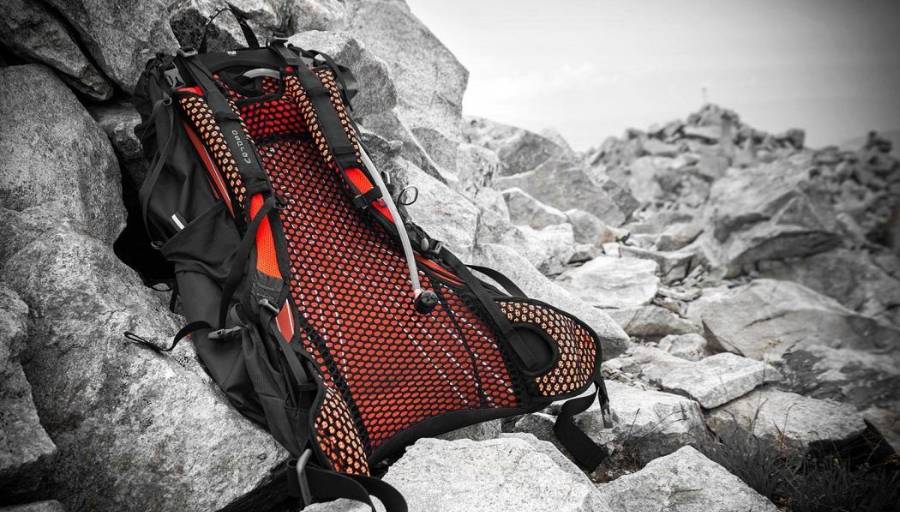
The hold of the pack on the back is guaranteed by a minimalist but effective belt and the chest strap (integrated whistle + +/- top adjustment system). In addition, the dorsal net perfects the feeling of contact with the back to become one without pressing on the shoulder blades or hips, for example.
I also use it when passing a trudge in a chimney. Also, the inner aluminum structure is very flexible and reacts well to the movements of the body in action.
When it comes to compression, the bag relies on minimalist Z straps with two rings. These are reminiscent of the traditional straps once used to secure mountaineering crampons—an old design, but one that remains highly effective.
Durability
Besides the frame, there is the harness running parallel. Despite my experience with the Atmos AG, whose shoulder straps are also foam-padded, I harbored some reservations about these particular straps.
Again, completely blown away! Tested with more or less heavy loads (the Exos has a capacity of up to 20 kg), it never pulls on the shoulders. The foam completely absorbs the pressure and avoids the tourniquet! Besides this, its breathable structure reduces sweat saturation in the collarbones.
Adjustability and Versatility
The other major asset of the Osprey Exos 38 backpack is its majestic net that unfolds over the entire back. Firmly taut but flexible like on the Atmos AG 65, you could (almost) trampoline on it.
Suddenly, the contact is super pleasant and adapts perfectly to the ergonomics of the curvature of the back at the same time as it marries the bumps of the shoulder blades. It’s just a matter of properly adjusting the straps of the shoulder straps to find the right measure of comfort.
The clearance between the netting (hence your back) and the back panel varies from 2 to 5 cm. This design ensures optimal ventilation. The moisture transfer is genuinely excellent, and you essentially “dry” as you continue walking. Moving forward, the breathability responsibility lies solely with your T-shirt.
Accessorize
The bag is made up of a single volume for storing your belongings. There is no specific compartment at the bottom for the sleeping bag. A separate compartment is dedicated to the placement of a water pocket, which is large enough for me to put mine of 3 liters.
With small practical detail, a clip makes it possible to fix the bag and the pipe so that they do not move and come off and thus flood your whole backpack. Two loops are placed along the shoulder straps to guide the hose and prevent it from wandering.
Closing System
The closing system is classic at Osprey: you can open wide for easy access to the contents of the backpack, then you pull the drawstring, which locks automatically. No need to tie a knot that is always difficult to undo afterward.

The Osprey Exos 38 backpack has a top flap with two pockets, an outer one spacious enough to fit more than just two hands, and an inner net for personal belongings with hook for keys. If you are looking for ultra-light, know that this upper part is easily detachable (4 clips to remove it in a few seconds).
An integrated floating flap acts as a canvas and will cover your bag.
Pocket and Space
I find the outside pocket very practical, as I often use it to store small essentials like my phone, sunscreen, energy bars, and tissues. However, I miss having pockets integrated into the belt. Osprey has addressed this in its Exos bag by adding two large side pockets, perfect for a water bottle or even a small photo tripod. The top and bottom horizontal openings provide flexibility in how these pockets are used.
A large stretch mesh pocket in stretch mesh ( PowerMesh ™) is located on the front of the bag to put a jacket, a hat, the legs of unzippable pants… A little lower, an ice ax loop with an elastic band to fix the handle higher.
Even lower, two straps allow you to attach a mattress or a tent to the bag to keep room inside for the rest. If you regularly hike in wet conditions, you may also want to compare it with these best waterproof backpacks for hiking, especially if weather protection is a higher priority than minimizing pack weight.
A series of loops are also arranged along the bag (2×3) and the upper flap (2×3) to attach carabiners, quickdraws, slings, strings… Dear Osprey, we find the Stow-on-the system -Go™ to attach hiking poles quickly. Personally, it’s never something I think of using, although I do not doubt that it could be practical.
Who Is the Osprey Exos 38 Best For?
The Osprey Exos 38 is a good fit for hikers and backpackers who prioritize low weight, ventilation, and comfortable load carrying over extra features. Its suspension and airy back panel make it particularly appealing for warm-weather hiking.
It is less suitable for hikers who need maximum organization, large hip-belt pockets, or a heavily featured pack. If you regularly carry bulky equipment or heavier loads, a larger or more supportive backpack may be a better match.
FAQs about Osprey Exos 38 Hiking Backpack
How does the pack handle weight distribution?
The suspension system is praised for its comfort, with weight distribution recommendations at 75% on the hips and 25% on the shoulders. This results in a balanced center of gravity at mid-back. For longer trips where you need to carry more specialized outdoor equipment, a larger bushcraft backpack provides a better balance of capacity, organization, and durability.
Is the Osprey Exos 38 suitable for different body types?
The fit depends on the specific Exos 38 generation and available torso sizes. Check Osprey’s current sizing information for the model you’re buying and adjust the harness and hip belt to achieve a secure fit.
Are there any common issues with the Osprey Exos 38 reported by users?
A recurring issue is the frame squeaking where the shoulder strap attaches to the top of the pack. However, you can fix this issue by placing a small foam piece between the shoulder strap and the frame.
Is the Osprey Exos 38 suitable for hot weather?
Yes, the Osprey Exos 38 is well-suited for use in hot weather. The backpack features optimal ventilation, and the design allows for effective moisture transfer. The gap between the netting (which rests against your back) and the back panel allows air to circulate.
How much gear can the Osprey Exos 38 hold?
The Osprey Exos 38 provides 38 liters of storage, making it suitable for lightweight overnight trips, shorter backpacking trips, and day hikes when you need to carry extra layers or equipment. The actual amount of gear you can pack depends on how compact your equipment is and how much food, water, and clothing you carry.
Can you remove the top lid on the Osprey Exos 38?
Yes. The top lid is removable, which allows you to reduce some weight and simplify the pack when you don’t need the additional storage or closure system. The pack also includes an integrated FlapJacket, which can be used to cover and secure the main compartment when the lid is removed.
The Verdict
After using the Osprey Exos 38 in warm-weather conditions, its biggest strengths are clear: low weight, excellent back ventilation, and a suspension system that remains comfortable when properly adjusted. The minimalist design also keeps the pack relatively simple and efficient for hikers who don’t need a large number of extra features.
The trade-off is storage and convenience. The lack of hip-belt pockets and included rain cover may be frustrating for some users, on the other hand, the 38-liter capacity can be more than necessary for a general day hike. Overall, the Exos 38 makes the most sense for lightweight hiking and backpacking where ventilation and carrying comfort matter more than maximum organization or features.