
10 Best Backpacking Tarps in 2026 for Lightweight Camping

Carrying a heavy tent can add unnecessary weight to your backpack, especially on long-distance hiking trips. A backpacking tarp offers a lightweight, versatile alternative, providing shelter from rain, wind, and direct sunlight without the bulk of a traditional tent.
However, choosing the right tarp requires more than comparing weight and price. Fabric durability, waterproof ratings, coverage area, attachment points, and setup flexibility all affect how well a tarp performs outdoors.
In this guide, we compare 10 backpacking tarps for 2026, covering options for ultralight hikers, hammock campers, budget-conscious backpackers, and those who prioritize dependable weather protection. We’ve evaluated their specifications, construction, available features, practical advantages, and limitations to help you find a shelter that matches your outdoor needs.
🏕️ Best Backpacking Tarps of 2026 — Comparison Table
From ultralight designs to heavy-duty waterproof options, these tarps provide protection from rain, wind, and sun while keeping your gear and campsite dry.
| Tarp | Best For | Weight | Size Coverage | Material & Durability |
|---|---|---|---|---|
Rain Fly EVOLUTION | All‑around Protection | 1.5 lbs | 12′ × 10′ | Diamond Ripstop – rugged and waterproof |
Tinkenken Tarp | Survival/Backpacking Kit | 4.4 lbs | 9.8′ × 13.1′ | Polyester with PU coating – weather‑ready |
Wise Owl Outfitters Tarp | Under $50 Everyday Tarp | 1.625 lbs | 11′ × 9′ | Ripstop Nylon with waterproof taping |
LiteOutdoors Ultralight Tarp | Ultralight Backpacking | 16.9 oz | 10′ × 10′ | Silnylon – lightweight & versatile |
Aqua Quest Waterproof Tarp | Best Waterproof Protection | 1.5 lbs | 10′ × 10′ | Coated Nylon with dual PU/Silicone barrier |
How We Evaluated These Backpacking Tarps
We evaluated these backpacking tarps using several criteria that matter during hiking and overnight camping:
- Weight and portability: How easily each tarp fits into a backpack and whether its weight makes it suitable for lightweight trips.
- Weather protection: Fabric coatings, waterproof ratings, seam construction, and overall rain coverage.
- Material durability: Ripstop construction, fabric thickness, reinforced corners, and attachment-point design.
- Coverage and versatility: Available dimensions, tie-out locations, and suitability for hammock camping or ground shelters.
- Setup and accessories: Included stakes, guy lines, adjusters, and ease of pitching different configurations.
- Value and support: Price relative to construction, included accessories, warranty coverage, and manufacturer support.
Our recommendations consider manufacturer specifications, available product information, and practical differences between the models. Product specifications and included accessories vary by size or version, so check the current listing before purchasing.
Best Backpacking Tarps Reviews 2026
Without further delay, let’s see our ranking of the best backpacking tarps of 2026:
- Rain Fly EVOLUTION – Best Overall
- Tinkenken – Best Survival Backpacking Tarp
- Wise Owl Outfitters – Best Backpacking Tarp Under $50
- Sanctuary SilTarp – Best Backpacking Tarp for Multiple Use
- OneTigris Bulwark – Best Backpacking Tarp for Camping
- WildVenture – Best Backpacking Tarp on a Budget
- LiteOutdoors – Best Ultralight Backpacking Tarp
- Aqua Quest – Best Waterproof Backpacking Tarp
- Bearhard – Perfect Balance in Durability and Portability
- Gold Armour – Available in different Sizes for All Demands
Let’s see in-depth…
1. Rain Fly EVOLUTION Hammock Tarp

Specs:
- Weight: 1.5 lbs.
- Material: Diamond Ripstop
- Size: 12 X 10 Feet
- Heavy Rain: 100% Waterproof
The Rain Fly Evolution backpacking tarp is designed with comprehensive features for staying safe and dry. It serves as an alternative to a tent. The 12 X 10 feet size makes every survival task easier under the tarp, even cooking food. It weighs only 1.5 pounds, which is truly lower than a higher-quality 32oz hiking water bottle.
This tarp is made of heavy-duty and authentic Diamond Ripstop material with the highest quality 2000 PU waterproof rating, making it an ideal sunshade for camping and ultralight backpacking adventures.
It is free from sun rays, snow, or torrential rains, and the fabric won’t make as much noise as a blue poly tarp (if secured properly). The 5-in-1 military-grade survival kit bracelet and compass make navigating in heavy rains easy. It features a WHISTLE that saves your voice, so you can hear 10 times farther, scaring away all dangerous animals.
This evolution backpacking tarp is also designed to keep you safe from high winds. However, the stakes are not long or stout enough to secure this fly. But for the price, the build quality of the fly itself as well as several of the kit components, will impress you.
Pros
- Ultralight backpacking tarp
- Ample space for any activity
- Good coverage and ready-to-use
- Block rain and UV rays protection
- Looks very pleasant
Cons
- Instructions are not clear
- Grommets are sloppily placed
2. Tinkenken with Hammock Rainfly Tarp

Specs:
- Weight: 4.4 lbs.
- Material: Polyester
- Size: 9.8 X 13.1 Feet
- Heavy Rain: 100% Waterproof
If you are looking for the best survival backpacking tarp with all the necessary accessories, then don’t look further. Tinkenken hammock rainfly is made of ripstop polyester with a silver coating on the inner surface, which makes this tarp waterproof, sunscreen-resistant, and weather-resistant.
This rainfly is made from solid polyester and PU coating that definitely won’t let any water through. All parts are good, and the outer edges will not come apart. The pole is widely adjustable; you can adjust the poles to 2.9 ft, 4.4 ft, or 5.9ft for assembly; just need to press the spring and push in. For disassembly, just pull it.
Tinkenken tent tarp is lightweight (not ultralight) and compact. It is a complete package and includes a tarp kit with 2 poles, 1 hammer, 6 aluminum stakes, and 6 nylon guy lines. You don’t need to buy anything separately. The poles feel a bit flimsy, but I’ve managed okay with this set. I’ve been able to set it up solo through perseverance.
The 9.8 x 13.1ft size is big enough to cover the entire hammock or tent to protect gear from bad weather, whether it is sun rays or heavy rain. It has 8 metal grommets for easy setup. Overall, this Shelter tarp could be perfect for camping, backpacking, hiking, traveling, bushcraft, or other outdoor activities.
Pros
- Easy to set up
- High-quality fabrics
- Excellent choice for multi-purpose
- Large size and adjustable poles
- Plenty of cordage comes in the kit
- Very cheap price
Cons
- Included stakes could be better
3. Wise Owl Outfitters Backpacking Tarp

We have had a great experience with Wise Owl Outfitters because of its family-friendly customer service. Now all of their products seem to be high quality, and the prices are reasonable. This is the best heavy-duty backpacking tarp under $50 that provides reliable foul-weather protection to keep campers and hammock sleepers happy and dry.
Owl Outfitters backpacking tarp is built to last and protect you from rain to shine. It has plenty of coverage, protecting you from the sun’s rays. It is made with ripstop waterproof nylon, taped seams, and an impenetrable water barrier for cover against all unacceptable weather conditions.
This hiking tarp is equipped with aluminum tent stakes, tie lines, and cords that tighten at every corner, and you can set it up like a breeze. However, this rain fly might cause problems for some users due to its shape, but you can choose different sizes to find the solution.
We can say that if you’re a lightweight backpacker or prioritize minimizing carrying weight, the Wise Owl Outfitters tarp is a suitable option. It serves well for various occasions, such as hiking, camping, and other adventures. The convenience of a waterproof carrying bag adds to its practicality and ease of transport.
Pros
- Extremely light
- High-quality and ultra-durable
- Combined with anti-insect interior
- Tight string adjustments
- Works great in rainy weather
Cons
- Small size
- Carrying bag is bulky compared to the tarp size
4. Sanctuary SilTarp Versatile Tarp Shelter

Specs:
- Weight: 1.2 lbs.
- Material: 30 denier rip-stop nylon
- Size: 12 x 10 Feet
- Heavy Rain: 100% Waterproof
Sanctuary Tarp Shelter is one of the lightest silnylon models on our list, thanks to its ultralight 30 denier rip-stop nylon. It features 60 feet of 1.5 mm reflective Dyneema guy line, six micro line-lok adjusters, and six aluminum Y-stakes. These components collectively enable a wide range of configurations.
The 30 Denier ripstop nylon also has silicon/PU dual-coating and fully taped seams, which provide up to 5,000 mm of hydrostatic resistance, making it ideal for camping, picnics, hiking, and more vacations. We assure you that you can be sure you’ll stay bone dry even in heavy rainy weather.
The 12 x 10-foot flat tarp weighs only 22 ounces, while the full kit is 27 ounces. The stakes and lines are also pretty compact. The included 9 x 5 x 5-inch stuff sack helps you organize your tarp perfectly after use.
The flat shape with 16 perimeter attachment loops and one center loop ensures unlimited flexibility. You can pitch the perfect shelter or hammock setup. Sanctuary backpacking tarp can also be used as a ground shelter. The manufacturer also offers a lifetime warranty.
Pros
- Package includes everything you need
- Many shelter configurations
- Waterproof and lightweight
- Flexible to carry
- Lifetime warranty
Cons
- Although it is effective in withstanding wind, it produces noise when rustling
- The logo stamped on the tarp is backward and crooked
5. OneTigris Bulwark Tarp for Camping

Specs:
- Weight: 2.4 lbs.
- Material: 210T Polyester Taffeta
- Size: 13 x 9.2 Feet
- Heavy Rains: 100% Waterproof
OneTigris is an all-season lightweight hiking and camping tarp. It is 100% waterproof and UV-resistant. The inner space is large enough for 2-3 people with plenty of space to move around the tarp. It is made of 210T Polyester Taffeta with dual PU coating and heat-taped seams that provide long-lasting protection and keep you completely dry.
You can set up this tarp shelter in different ways, giving you the most coverage. For example, you can use it as a hammock tarp, a tent fly, a groundsheet, a quick shelter, etc. With 19 reinforced webbing loops or grommets, including 3 on the ridgeline, the quality of the tarp itself is phenomenal.
The waterproof rating is 2000mm, making it a good choice for hammock camping or as a bushcraft shelter. The practical coyote brown color ensures better blending in the wild. Because of its multiple tie points, you can configure it in different ways.
OneTigris Bulwark Camping Tarp comes in a waterproof stuff sack for easy storage. It is certainly well-designed, crafted, and compact enough for group backpacking trips. Remember, if you don’t fold the rainfly properly as you received it, it won’t fit back into the stuff sack.
Pros
- Versatile and durable backpacking tarp
- Portable and lightweight
- Suitable for use around the year
- Superb waterproof
- Large space
Cons
- Stuff sack is nice but a little small
- There are no instructions
6. WildVenture Backpacking Tent Tarp

WildVenture Rain Fly Tent Tarp is an ultralight backpacker’s dream. However, it is waterproof and the total weighs less than 2 pounds. It is large enough to protect you when the weather gets tough. It has 16 different fasteners — four on the corners, two for the ridge line, three on each long side, and two on each wall.
The fabric component is constructed from superior ripstop nylon, known for its tear-resistant properties. It features a waterproof coating, making it effective in repelling water, and it is designed to be UV-resistant, which offers protection against the sun’s rays. Whether you’re in the desert, forest, beach, backyard, or living off the land survivalist-style, the WildVenture waterproof rain fly has everything you need to construct the perfect shelter.
It is easily foldable and equipped with a storage bag so that users can easily carry or store it. With the huge 13′ x 13′ size and 25 fixing points, you can pitch this tarp in multiple configurations.
This tarp can be used as an awning, tent canvas, hammock shelter, picnic blanket, parasol, or beach mat. It can be set up and taken down in mere minutes. The package also includes an extra set of stakes, ensuring your tarp gets maximum anchoring power. Overall, if you’re looking for a long-lasting backpacking tarp without breaking the bank, we highly recommend this model.
Pros
- Includes an extra set of stakes
- Made of durable and lightweight materials
- Shelter from all weather
- Easy to set up
- Cheap price
Cons
- Doesn’t have tie-outs in two places
- Extra large size
7. LiteOutdoors Silnylon Ultralight Tarp

Specs:
- Weight: 16.9 oz.
- Material: Silnylon
- Size: 10 x 10 Feet
- Heavy Rains: 100% Waterproof
LiteOutdoors backpacking tarp is made from 20D ripstop nylon with a silicone coating on both sides. The square dimension of 10 x feet is largely sufficient to create a waterproof flysheet above a tent, a hammock, or a cooking area. There is also an 8′ x 10′ size available.
LiteOutdoors tarp is rated at over 2000mm hydrostatic head and 100% waterproof. The material is thin but durable. The high-quality polyurethane (PU) coating enhances the tarp’s suitability for picnic camping, ensuring it keeps you warm, dry, and safe during your hike. This coating provides effective protection against direct sunlight, snow, or torrential rains.
The package offers a complete tarp kit, eliminating the need for additional accessories. Each tarp comes with 18 tie-down points and 16 Line Lok micro adjusters positioned around the perimeter. However, it is not seam-sealed, but comes with a tube of silicon sealant for you to do at home.
Overall, if total weight or space is a concern for you, this tarp is the way to go, as it is one of the lightest tarps on the market, packing down amazingly small. You will be surprised by its versatility and multiple pitch configurations!
Pros
- Versatile design
- Incredibly lightweight
- Compact and looks fantastic
- Cheap price
- Complete package
Cons
- Not seam-sealed
- Not available in large size right now
8. Aqua Quest Green Waterproof Tarp

If you’re looking for a waterproof and durable backpacking tarp for long-term use, look no further than the Aqua Quest Guide. This tarp has a square cut and 16 fasteners for maximum versatility. You can add an Echo mesh insert for extra protection from rain and pesky bugs.
This model is very light and packs down well. You can use it as a hammock, as it allows for enough coverage in case of inclement weather but not so much that you are unable to feel too enclosed.
The Aqua Quest tarp will keep you completely dry, even in heavy rain. And with dual coatings of non-toxic Polyurethane and Silicone, you will be safe from a single drop of water. It provides a total coverage area ranging from 64 to 234 square feet. The design ensures coverage from all angles. If the square is too big, you can make it smaller with the rectangular version.
It packs up incredibly small, making it almost unnoticeable in your load, allowing you to fit it into almost any small space. The integrated webbing for easy staking and the webbing in the center for straightforward attachment to a higher point are features that we particularly appreciate.
Pros
- Versatile
- Very well made
- Packs down well and is small
- Ultralight and compact
- Lifetime warranty
Cons
- Color is too visible
- Very light material
9. Bearhard Camping Tarp Portable Rainfly

Specs:
- Weight: 2.5 lbs.
- Material: Polyester, Nylon
- Size: 10 x 12 Feet
- Heavy Rain: 100% Waterproof
The Bearhard tarp rainfly boasts a rectangular-shaped design, presenting itself as a seamless flat tarp equipped with 16 fasteners. Despite being a small camping tarp, it is easily assembled even in limited spaces. Weighing in at just 2 lbs, it offers a perfectly balanced and lightweight option.
Surprisingly, this compact tarp manages to cover over 100 square feet of ground while maintaining extraordinary durability. With a waterproof rating of 3000mm and numerous setup configurations, it ensures reliable protection in various weather conditions.
It is designed to serve as a camping tarp, hammock rainfly, tent footprint, or even a simple tent all-in-one. The special reinforced design makes it easy to set up within 2 minutes. This gives you convenience for different activities like camping, hiking, backpacking, fishing, climbing, hunting, etc.
It has 3-layer corners with a reinforced pole ring, triangle tensioner, and double-stitched edge that give you extra confidence in bad weather. This hiking tarp comes with 6 nylon ropes, 4 aluminum stakes, and 16 holes. It’s a complete setup and comes well packaged. Both the carry sack and tarp are well made. This model is available in rectangular and square shapes; both cost less than 40 dollars.
Pros
- Reliable outside protection
- Reinforced materials and design
- Tough and well sealed
- Easy to set up and carry
- Affordable
Cons
- Doesn’t have color options
10. Gold Armour Rainfly Hammock Tarp

Specs:
- Weight: 2.3 lbs.
- Material: Ripstop Fabric
- Size: 12 x 10 Feet
- Heavy Rains: 100% Waterproof
The Gold Armour Backpacking Tarp offers an exceptional size-to-weight ratio. At just 2.3 lbs, the tarp covers an impressive 108 square feet, which allows three people to sleep comfortably. You can choose from the different sizes that work best for you. The available sizes are 14ft x 12ft, 12ft x 10ft, 10ft x 10ft, and 10ft x 8ft.
The material is ripstop polyester, backed with Polyurethane Coating that won’t stretch and sag like nylon. It has a Durable Water-repellent application on the face. It will keep you dry and comfortable with unparalleled weather protection, with a water-shedding capability of up to 5,000mm.
With 33 tie-down loops for multiple anchoring points, this model can be used as a tent tarp, hammock shelter, simple tent, tent footprint, groundsheet and blanket, instant shade, and more. However, the stakes are a bit flimsy, so it’s difficult to drive them without bending them.
Gold Armour tarp bears a striking resemblance to the DD tarp, yet it comes at a significantly more affordable price, less than half of the DD tarp’s cost. The package includes a rainproof gear sack, enhancing the ease of storage and transport. An extra advantage is the 5-year warranty offered by Gold Armour.
Pros
- Best value in one complete package
- High-quality and durable tarp
- Weatherproof and versatile
- Handles the rain flawlessly
- 5-year warranty
Cons
- A little bit heavy
- It doesn’t pitch tightly enough
Final Comparison: Choose the Right Backpacking Tarp
After reviewing all 10 backpacking tarps, use this final comparison to revisit the key differences at a glance. Compare weight, coverage, and intended use of each model to narrow down your shortlist and decide which tarp best matches your backpacking needs.
| Tarp | Best For | Weight | Size |
|---|---|---|---|
| Rain Fly EVOLUTION | Best Overall | 1.5 lbs | 12 × 10 ft |
| Tinkenken | Survival Backpacking | 4.4 lbs | 9.8 × 13.1 ft |
| Wise Owl Outfitters | Best Under $50 | 1.625 lbs | 11 × 9 ft |
| Sanctuary SilTarp | Versatile Shelter | 1.2 lbs* | 12 × 10 ft |
| OneTigris Bulwark | Camping | 2.4 lbs | 13 × 9.2 ft |
| WildVenture | Budget Camping | 2 lbs | 13 × 13 ft |
| LiteOutdoors | Ultralight Backpacking | 16.9 oz | 10 × 10 ft |
| Aqua Quest | Waterproof Protection | 1.5 lbs | 10 × 10 ft |
| Bearhard | Durability | 2.5 lbs* | 10 × 12 ft |
| Gold Armour | Multiple Size Options | 2.3 lbs | 12 × 10 ft |
*Verify Sanctuary SilTarp and Bearhard weights against the exact product versions. Listed specifications may vary by size or configuration.
Before pitching a tarp in wet weather, choose a suitable campsite and prepare for changing conditions. Leave No Trace’s camping-in-the-rain guidance offers practical advice on campsite selection and preparation.
Best Backpacking Tarps – In-depth Buying Guide
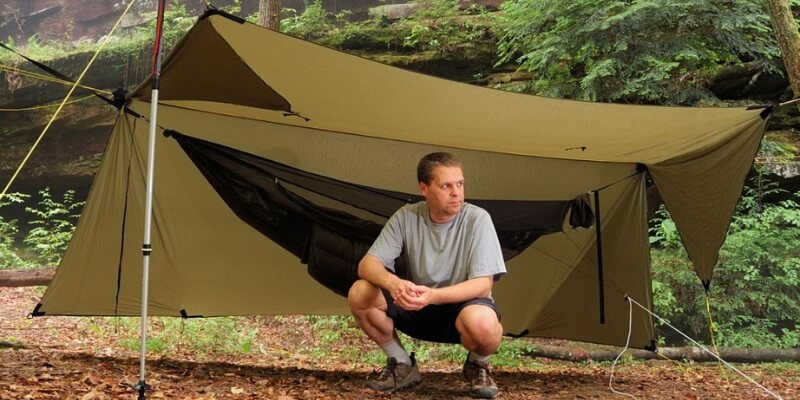
When searching for the best backpacking tarps, a well-rounded buying guide can be incredibly helpful. Here are the key factors to consider:
What Size Backpacking Tarp Do You Need?
Choosing the right tarp size depends on the number of people, sleeping arrangement, and expected weather conditions.
- Solo backpacking: A tarp around 7 × 9 feet can work for minimalist setups, although larger dimensions provide better coverage.
- Two-person backpacking: Consider a tarp around 10 × 10 feet or larger for additional sleeping and gear space.
- Hammock camping: Choose a tarp long enough to cover the hammock, with sufficient overhang at both ends to protect against wind-driven rain.
- Exposed or rainy environments: A larger tarp provides more pitching flexibility and better coverage, especially when configured with lower sides.
Remember that usable shelter space depends on the tarp’s shape, pitch height, and configuration. A larger tarp also adds weight, so balance coverage against your backpacking priorities.
The Weight
If you’re considering purchasing a backpacking tarp, it indicates a desire to reduce weight. However, not all tarps are created equal. Weight can vary significantly based on material, thickness, and size, ranging from 0.7 lbs to 4 lbs or more. When a tarp becomes excessively heavy, carrying a tent can be more practical.
Unfortunately, lighter tarps often come with a higher price tag. If ultralight hiking and quick mobility are your priorities, the added expense may be well worth it. However, if your trip involves staying in one location for several nights, you might prefer a slightly heavier tarp that offers greater durability and comfort.
The Size
A tarp that folds compactly not only trims down weight but also enables you to use a smaller backpack. If you find it challenging to allocate space in your larger backpack for all your essentials, opting for a smaller tarp can be a space-saving solution.
While the packed size is crucial, it’s equally important to consider the unpacked size. Why? Because the size of your tarp matters when it comes to sleeping and storing your belongings. A larger tarp not only provides more space but also offers greater flexibility in construction techniques to adapt to various weather conditions. Since tarp camping exposes you to the weather, opting for a larger tarp is advisable for enhanced protection and comfort.
For solo backpackers, we recommend a tarp of around 7.43 m² or more, and 9.29 m² would be ideal for two people. Most two-person tarps have room for two sleepers and a few storage bags, along with backpacks and extra gear. However, if you want more interior space for camping comfort, you can increase one size.
The Materials
Modern tarp shelters are generally made of three materials, namely silnylon, silpoly, or Dyneema Composite Fabric, also known as Cuben Fiber.
Silnylon and Silpoly are made of a nylon or polyester base covered with silicon to improve the seal. Both are great choices in terms of durability, reliability, and cost. Nylon is extremely abrasion resistant, while polyester does not “stretch” as much and can be manufactured at lower costs than nylon.
Cuben is like a Synthetic Sandwich. It is made of several layers of high-strength synthetic fibers. However, it offers excellent tensile strength (so it is difficult to tear) and is extremely light. But as you might expect, the added complexity dramatically increases its price.
Maintenance
Maintaining and repairing various tarp materials is generally straightforward, as most manufacturers provide repair kits for easy use. However, it’s important to note that a basic roll of duct tape can be sufficient for a quick midnight repair on a Cuben tarp.
In contrast, repairing silnylon or silpoly can be more intricate, as it involves using a silicon-based adhesive along with patches for both sides.
Tarp Shape
In the past, acquiring a flat tarp usually meant opting for an older model, and squares or rectangles were challenging to come by. Fortunately, advancements in manufacturing technology have expanded the available shapes. Modern tarps often feature a curved line in the center or curved edges, facilitating the creation of a waterproof surface when all corners are properly threaded and anchored. This design minimizes loose fabric that could flap in the wind.
Nevertheless, there’s a trade-off. Tarps with these designs require consistent threading in the same position each time, limiting the incredible flexibility associated with a flat tarp. If you opt for the traditional flat tarp, consider whether a square or rectangular shape aligns better with your needs.
The square tarp, owing to its symmetry, tends to be more versatile. Depending on your preferred tarp configuration, a rectangular tarp may suit your requirements.
Functionality
Regardless of its size or lightness, a tarp without an anchor point is useless! It is necessary to make sure that the backpacking tarp you choose has enough eyelets around its perimeter. This will allow you to secure the tarp in your preferred configuration.
While four is the smallest setup for one per corner, six or eight are preferable. It is not essential but can be practical if the tarp includes one or more “points of support” in the middle. This allows it to be supported from the inside. This will create more free space and help keep the walls taut, reducing movement in strong winds and improving drainage.
It is common to see backpacking tarps offered with some degree of modularity. This means that besides the basic waterproof tarp, you can buy an internal base installed under the main tarp for additional protection against insects. Similarly, some manufacturers offer a removable floor mat. Essentially, it turns your tarp into a non-standalone tent! These expansions come with additional weight and cost.
Weatherproof
A backpacking tarp must provide excellent weather protection to ensure your safety, keep you dry, and retain warmth when used correctly, even in harsh conditions. A hydrostatic resistance rating of 20,000mm guarantees exceptional water repellency, ensuring no moisture seeps through the fabric.
Also, some hiking tarps feature canopies, vestibules, or doors for enhanced protection against severe weather.
FAQs About Best Backpacking Tarps for 2026
What is the best material for a backpacking tarp?
Silnylon, silpoly, and Dyneema Composite Fabric (DCF) are popular backpacking tarp materials. Silnylon offers flexibility and good tear resistance, while silpoly generally stretches less when wet. DCF is extremely lightweight and waterproof but typically costs more. The best option depends on your budget, weight priorities, and intended use.
Is a backpacking tarp better than a tent?
A backpacking tarp can be lighter, more compact, and more versatile than a traditional tent. However, it usually provides less protection from insects, wind-driven rain, and cold weather unless paired with additional components. A tent is often more suitable for beginners or exposed environments.
Do backpacking tarps need a groundsheet?
Not necessarily. A groundsheet is useful when sleeping directly on the ground because it helps protect your sleeping gear from moisture, dirt, and abrasion. However, hammock campers and hikers using elevated tarp shelters may not need one.
What are the benefits of using a backpacking tarp?
Backpacking tarps are lightweight and compact, making them ideal for backpackers and hikers who need to travel light. They are versatile and can be set up in a variety of configurations to suit different camping situations. Additionally, tarps provide better ventilation than tents, which can be especially helpful in warmer climates.
Are backpacking tarps suitable for all seasons?
Backpacking tarps can be suitable for all seasons, depending on the design, material, and setup. Some tarps are specifically designed for warmer seasons and offer better ventilation, while others are equipped with additional features like doors, panels, or extra guy lines for improved weather protection in colder or more challenging conditions.
How do I set up a backpacking tarp?
Backpacking tarps can be set up in various ways, depending on the configuration you prefer. Common setups include the A-frame, lean-to, and pyramid styles. Practicing your tarp setup before heading out on a trip is essential to master the techniques for securing it properly and to identify any adjustments you may need to make.
How do I care for my backpacking tarp?
To care for your backpacking tarp, be sure to clean and dry it after each use. Avoid storing it in damp or humid conditions, which can lead to mold and mildew growth. If your tarp becomes damaged, repair it promptly to prevent further damage.
Can I use a backpacking tarp as a hammock tarp?
Yes, many backpacking tarps can be used as hammock tarps. However, make sure to choose a tarp shelter that is large enough to provide adequate coverage. Also, consider any extra hardware or accessories necessary to secure the tarp effectively to your hammock and the surrounding trees or supports.
Conclusion
A good backpacking tarp should match your trip, not simply offer the lowest weight or most extensive coverage. If you travel long distances, a compact ultralight model can help reduce pack weight. For hammock camping or longer stays at a campsite, prioritize adequate coverage, reinforced attachment points, and reliable construction.
Among the options reviewed above, consider the LiteOutdoors for weight-conscious trips, Sanctuary SilTarp for versatile shelter configurations, or OneTigris Bulwark for a larger camping setup. Compare their specifications carefully before deciding, as included accessories and actual packed weights can vary.
Whichever model you choose, practice pitching it at home before relying on it in the wilderness. A suitable setup and proper site selection are just as important as the tarp itself.




Over the years I have enjoyed perfecting the design of a tarp shelter with fire inside.
I will list a few things I have learned.
1. There are some serious situations in this life and one is how much wood and time it
takes to boil water for morning coffee. I can do it inside my tarp shelter on a 24 oz chimney/stove in about 10 minutes. A cookstove oriented vertical burns more efficient with a hotter cooktop even when the firewood is too green. Common hot tent stoves take forever to get the coffee going. They are horizontal without a smoke baffle. People with these stoves often use a little gas stove first thing in the morning.
2. A cookstove with a baffle does not need a spark arrestor.
3. The contrast between cooking inside your shelter or outside is like day and night. Like, with a chimney or without a chimney. Completely comfortable or shivering in the wind.
Recreational campers use what they claim is 4 season tents and stoves and forbid cooking inside a shelter. It is roughing it so they only do it a few days out of the year and have the option of staying home and waiting for the wind to stop blowing.
There is no good 4 season camping without fire that is not fire outside in the wind it is fire inside a tarp shelter.
4. A 2”x36” chimney, 5”x5” stove is minimum size but gets the cooking done.
5. A 10’’x10’ tarp can provide a sleep space on each side. There is only one way to pitch a tarp so sides can be tight to the ground ready for a blizzard or all sides raised to form an umbrella in summer sun. A tarp makes a better 4 season shelter than a tent with zippers that freeze. A tarp shelter is useless if all sides are not tight to the ground in windy bad weather.
6. An on the ground hammock bedding bag attached with Velcro along each tarp side stops all ground level drafts.
7. Any size square tarp and stove can be used. It all depends on how much wood you want to buck up and burn.
Keep warm clothes on 24/7 and use a small cookstove on a chimney.
Fire a big stove for a hot tent.
8. A chimney can serve as the centrepole for a shelter, providing solid stability for the stove.that hangs on the side.
9. The hot floor of my cookstove can broil diced bacon in an open top kettle.
10. To keep my back warm and my bottom comfortable while sitting by the fire I attach a short bag to the back inside of my coat to hold a doubled sleep pad under my coat extending down far enough to sit on.
Arlen Smith or chimpac
Hi Arlen,
Thanks for sharing your detailed insights! You clearly have a lot of experience with tarp shelters and using stoves inside them. I really appreciate the tips about efficient vertical cookstoves, chimney setups, and keeping ground drafts out—it’s clear you’ve spent a lot of time refining your system.
For readers considering backpacking tarps, your points highlight how versatile a tarp can be for all-season use when paired with the right setup. I especially liked your tip about using the chimney as a center pole and the Velcro-attached bedding to block drafts—small adjustments like these can make a big difference in comfort.
Would you mind sharing your preferred tarp size and stove combination for lightweight backpacking trips? I’m sure many readers would find that extremely helpful.
Thanks again for your comment!