8 Best Hiking Trailers in 2026 for Backpacking & Gear Hauling


Carrying enough gear for a long-distance hike can quickly become challenging, especially when your route includes multiple days on the trail. While backpacks remain the standard choice for most hikers, they have practical limits when it comes to heavy camping equipment, food supplies, hunting gear, or specialized outdoor equipment.
This is where hiking trailers can provide a valuable solution. Designed to help transport larger loads with less strain on your body, hiking trailers distribute weight more efficiently than carrying everything on your back. They can be particularly useful for extended trekking expeditions, family camping trips, hunting adventures, and other outdoor activities that require extra gear.
Over the past several years, hiking trailers have gained popularity among outdoor enthusiasts seeking greater comfort and carrying capacity on longer journeys. Modern models are lighter, more durable, and better equipped to handle a variety of terrain, making them a practical option for hikers who need additional storage without sacrificing mobility.
To help you choose the right model, we evaluated the best hiking trailers available in 2026 based on factors such as durability, load capacity, terrain performance, ease of use, and overall value. Whether you need a trailer for camping gear, hunting equipment, or multi-day wilderness trips, this guide highlights the top options to help you find the best fit for your outdoor adventures.
Top 8 Hiking Trailers of 2026 – Comparison Table
Compare the top hiking trailers of 2026, including load capacity, weight, and quick Amazon links for easy shopping.
| Trailer | Image | Load Capacity | Weight | Price |
|---|---|---|---|---|
| Retrospec Rover Hauler |  | 80 lbs | 24.7 lbs | Check on Amazon |
| Burley D’Lite X, 1 and 2 Seat |  | 55 lbs / 25 kg | 4 lbs | Check on Amazon |
| Burley Travoy Cargo Trailer |  | 88 lbs / 40 kg | ~17 lbs | Check on Amazon |
| DuraMaxx Mountee-v2 |  | 132 lbs / 60 kg | ~35 lbs | Check on Amazon |
| M-Wave Bicycle Trailer |  | 88 lbs | ~22 lbs | Check on Amazon |
| Trollix Wagon 2-in-1 |  | 99 lbs / 45 kg | ~25 lbs | Check on Amazon |
| Monowalker Fatmate Expedition |  | 110 lbs / 50 kg | 22 lbs | Check on Amazon |
| DuraMaxx Carry Red Cargo |  | Varies by use | ~28 lbs | Check on Amazon |
How We Tested These Hiking Trailers
To select the best hiking trailers, we evaluated each model based on load capacity, frame quality, durability, ease of assembly, terrain performance, portability, foldability, weather resistance, and overall value. We also compared manufacturer specifications with verified customer feedback to identify long-term strengths and potential drawbacks.
The Best Hiking Trailers Ranking for 2026
- 1. Retrospec Rover Hauler – Best Overall
- 2. Burley D’Lite X Bike Trailer & Stroller – Editor’s Choice
- 3. Burley Travoy Cargo Trailer – Slim and Lightweight
- 4. DuraMaxx Mountee-v2 – Best on a Budget
- 5. M-Wave Bicycle Trailer – Widely Usable
- 6. Trollix Wagon – Best 2-in-1 Hiking Trailer
- 7. Monowalker Fatmate Expedition – Designed Detachable Wheels
- 8. DuraMaxx Carry Red Cargo – Best Small Hiking Trailer
1. Retrospec Rover Hauler Cargo Trailer
I enthusiastically recommend the Retrospec Rover hiking trailer for its exceptional practicality and heightened robustness. This equipment significantly enhances your experience during extended escapades on various types of terrain. This trailer is almost ready to use straight out of the box, which provides convenience and ease of use for your hiking needs.
The attachment consists of an aluminum frame and a steel axle. The two wheels are made of semi-soft rubber and measure 37cm in diameter each. It guarantees superior stability during movement on different types of terrain.
For unparalleled convenience, the frame located at the axle is adjustable. This design ensures an ideal balance. The support arms of the Retrospec Rover hiking trailer are adjustable in width, ensuring a perfect fit for individuals of all body types. These elements come equipped with a secure fastening system, enabling easy hanging and attachment.
This cart measures 27″L x 24.5″W x 20″H and weighs 24.7 lbs. It can support a maximum load of about 80 lbs. The accessory can be assembled completely in 5 minutes. When folded, you can carry the main piece on your back. The support arms (fully detachable) can also be used as hiking poles.
Pros
- Weather resistant
- Large carrying capacity
- Wide range compatibility
- Collapsible frame
- Easily foldable
- Has rear reflector
Cons
- No inner tubes
2. Burley D’Lite X Bike Trailer & Stroller – Editor’s Choice
If you’re looking for a lightweight alternative to carrying a heavy backpack, the Trekker’s Friend Hiking Trailer is the most innovative option available. Compared to conventional cargo or bicycle trailers, this hiking trailer is specifically designed for long-distance walkers, trekkers, and backpackers who want to reduce shoulder and back fatigue without sacrificing mobility.
What makes the Trekker’s Friend unique is its clever design. Instead of using a bulky frame, it works with your existing hiking backpack and trekking poles. It weighs only around 1.8 kg (4 lbs), making it one of the lightest commercial hiking trailers available. On smooth trails, dirt roads, and gravel paths, it allows your backpack to roll behind you, significantly reducing the effort required to carry heavy loads.
When the terrain becomes steep, rocky, or technical, the trailer can quickly be folded away and your backpack carried normally. During long-distance hikes, this flexibility is a major advantage. Rather than committing to wheels for the entire trip, hikers can switch between rolling and carrying depending on trail conditions.
The lightweight construction doesn’t compromise usability. The frame packs into a compact daypack, making transportation and storage simple. Since it relies on your trekking poles as part of its structure, it also reduces the amount of additional equipment you need to carry. According to the manufacturer, the system helps hikers move faster while reducing physical strain on suitable terrain.
Although the Trekker’s Friend performs exceptionally well on relatively smooth surfaces, it isn’t designed for extremely rocky mountain trails where constant lifting would be required. Like all hiking trailers, choosing the right terrain is essential for getting the best experience.
Pros
- Specifically designed for hiking
- Extremely lightweight (around 1.8 kg)
- Folds into a compact carrying bag
- Uses existing trekking poles
- Quickly switches between rolling and carrying
- Reduces shoulder and back fatigue
Cons
- Best suited for smooth or moderately maintained trails
- Less effective on technical mountain terrain
3. Burley Travoy Folding Cargo Bike Trailer
This is a 2-in-1 trolley, suitable for both hiking and cycling. It is equipment adapted to all terrains, including snow. The wheels have an ultra-fast fastening system. The wheels can cross many obstacles, such as sidewalks, stones, and roots. It is an excellent bike trailer and very easy to use.
The hand drawbar is made up of an articulated harness attachment. You will therefore be able to move as you wish, in a natural way, even to make a U-turn. However, the wheels are susceptible to flats.
Burley Travoy hiking trailer has 40 kilos load capacity. If you don’t walk, hang it behind your bike. The harness, which hooks around your waist, allows you to carry the cart while keeping your hands free.
It is a hiking trailer particularly suitable for pedestrian routes. Assembly time won’t take more than 3 minutes. The package also comes with a carrying bag.
Pros
- Quick hitch
- No tools or setup required
- Extendable tow arm
- Wide kickstand
- Lightweight and slim profile
Cons
- You need to adjust your riding style slightly
4. DuraMaxx Mountee-v2 Bicycle Trailer
This bicycle or hiking trailer is very robust and offers a safe and easy transport option, making it practical for all occasions. This mounted trailer transforms a classic bicycle into a load carrier. The frame is made of solid tubular steel, which gives it a large and particularly stable load capacity.
DuraMaxx Mountee-v2 hiking trailer comes with a heavy-duty nylon and water-repellent cover. The extender is attached to the frame to protect the load against the weather and wind. The powder coating gives it protection against oxidation and rust.
The base is reinforced by cross-welded flat steel, allowing intensive use. The load compartment is capable of supporting a maximum load of 60 kg. It is therefore a bicycle trailer that will transform the bicycle into a load-carrying machine.
While the trailer may have a slightly higher weight compared to other models, the wheels and bearings are estimable and complement the overall performance. The fit and finish are of high quality.
Pros
- Space-saving design
- Stable and robust construction
- Large platform
- Quality is good for the price
- Ideal for small family hiking
Cons
- The instructions are a bit complex to follow
No rear reflectors
5. M-Wave Foldable Luggage Bicycle Trailer
The M-Wave introduces a new model of hiking trailer designed to attach to most bicycles. Its simple and practical fixing mechanism makes it accessible to everyone. The trailer boasts straightforward assembly and folding. Despite its ease of use, it still provides ample space for errands and routine trips.
The hiking cart is truly exceptional, capable of supporting up to 88 lbs, an example of its robust design with a sturdy steel frame that enables it to handle such significant weights. Both the bar and the frame are constructed of durable steel. This trailer excels in simplifying the process of loading and unloading goods. Notably, the side parts are designed to fold inwards along with the front and rear doors.
M-Wave Folding Trailer is made of lightweight aluminum tubing, beautiful and shiny, and strong enough. Adjustments are made by moving nuts and bolts from one pre-drilled hole to another.
The section where the dog’s paws rest features a soft and durable neoprene fabric. This material is securely attached to the frame using either metal or plastic clips. Additionally, the dog wears a harness made of nylon and neoprene, providing a comfortable and secure fit. The harness is also attached to the frame.
Pros
- Foldable for storage
- Quick-release wheels
- Quickly attaches to most bicycle axles
- Wonderful welding
- Easy to assemble
Cons
- Tires could be improved
6. Trollix Wagon 2 in 1 Hiking Trailer
This detachable and collapsible aluminum and epoxy-coated bicycle trailer could also be a hiking trailer. It is equipped with 20-inch wheels, a reflector, and a 90 l luggage bag in 600D polyester. It is capable of carrying a maximum load of approximately 45 kg, the ideal load of which is between 20 and 25 kg.
This is therefore a two-wheeled trailer that could serve as a luggage rack for hiking or leisure, the adaptability of which is also possible for bicycles. It greatly assists hikers who want to bring their complete equipment to be as independent as possible while avoiding carrying everything in a backpack.
However, the Trollix Wagon 2 trolley is made for a very long life. Some parts are welded together. It performs very well because it is sturdy and the parts won’t break easily.
Trollix Wagon hiking trailer is also easy to use and can be equipped with fairly large wheels. A kit is available for the counterweight, which means the wheels can be moved forward to make the front of the cart lighter.
Pros
- Easy to install
- Impeccable quality
- All Terrain
- Very light
- Easy to use
Cons
- Nothing to say!
7. Monowalker Fatmate Expedition Cart
For serious expeditions and extended wilderness travel, few hiking trailers are as purpose-built as the Monowalker Fatmate Expedition Cart. Unlike general-purpose bicycle cargo trailers, the Fatmate is engineered specifically for hikers, photographers, hunters, and outdoor professionals who need to transport heavy equipment over long distances.
The notable feature is its ergonomic waist harness, which transfers much of the load from your shoulders to the trailer’s wheel. This significantly reduces fatigue and allows you to carry substantially more equipment than you could comfortably fit in a traditional backpack. The large off-road tire provides excellent stability on gravel roads, forest trails, and other uneven surfaces, and an integrated braking system helps maintain control during descents.
Its modular design is another major advantage. The trailer can accommodate different pack configurations and is built with expedition-level durability in mind. The manufacturer positions it for multi-day adventures where carrying additional food, water, photography gear, or camping equipment is essential. The current generation is being produced in limited numbers through a 2026 pre-order campaign.
Although the Monowalker delivers exceptional load-carrying capability, it is a premium investment. It’s also best suited to wide hiking trails, forestry roads, and open terrain rather than narrow, highly technical singletrack where any wheeled system becomes more challenging.
Pros
- Designed specifically for hiking expeditions
- Ergonomic waist harness reduces fatigue
- Excellent for heavy camping and photography gear
- Large off-road wheel
- Integrated braking system
- Rugged expedition-grade construction
Cons
- Premium price
- Better suited to wide trails than technical singletrack
8. DuraMaxx Carry Red Cargo Trailer
DuraMaxx cargo trailer can be a one-stop solution for daily use. By installing it on your bike, you transform it into a compact three-wheeled bike. Thanks to its unique and patented system, your bike will be easier to handle and more profitable than buying a complete cargo bike.
On the base, you can add the front dog trailer. Indeed, its use is multiple, each of which can have a means of moving daily according to their needs. However, my main concern lies with the catches that secure the bag to the frame; they appear to be less rugged and might not withstand heavy use.
Installing this trailer is very easy; just remove the front wheel of your bike and place the fork on the system. DuraMaxx hiking trailer has a quality, ready-to-use braking system.
The tilting wheel system enhances the driving experience by allowing optimized maneuvering based on your specific needs. By using the tilt lock lever on your handlebar, the trailer can stay stable when stationary. This makes it easier to load and unload the bike, and get on and off the bike. All fittings are also included.
Pros
- Swiftly attachable
- Comfortable haul
- Equipped with lateral handle
- Practical and robust
- Versatile
Cons
- Flimsy, not recommended for heavy-duty tasks.
Hiking Trailer vs Backpack: Which Is Better for Carrying Gear?
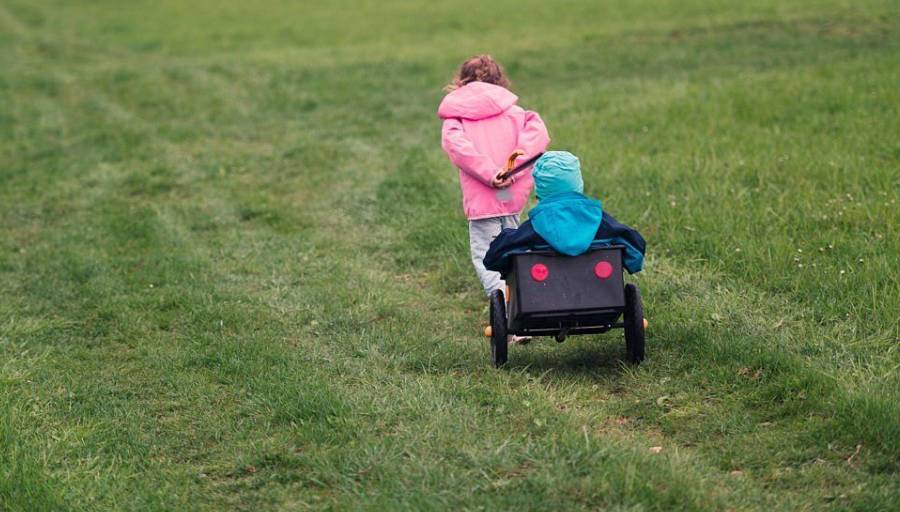
Understanding the differences can help you choose the most practical option for your outdoor adventures.
| Factor | Hiking Trailer | Backpack |
| Comfort | Reduces strain on shoulders, neck, and back by transferring most of the load to wheels. | Weight rests directly on your body, which can lead to fatigue during long hikes. |
| Weight Distribution | Carries heavy loads more efficiently with minimal pressure on the hiker. | Requires proper packing and fit to distribute weight evenly. |
| Carrying Capacity | Typically supports significantly larger loads, making it ideal for extended trips and bulky gear. | Limited by pack size and the hiker’s physical ability to carry weight comfortably. |
| Speed & Agility | Can slow movement on narrow trails, steep climbs, or technical terrain. | Allows faster movement and greater flexibility on challenging trails. |
| Terrain Performance | Works best on established trails, dirt roads, forest paths, and relatively smooth terrain. | Performs well on virtually all terrain, including rocky, steep, and off-trail routes. |
| Setup & Storage | Requires assembly, maintenance, and storage space when not in use. | Simple, lightweight, and easy to transport. |
| Best For | Multi-day expeditions, family camping trips, hunting gear, photography equipment, and hauling heavy supplies. | Backpacking, thru-hiking, mountain trekking, and routes with rugged terrain. |
If your trip involves carrying heavy camping equipment, photography gear, hunting supplies, or food for several days, a hiking trailer can significantly reduce fatigue. For shorter breaks and convenient trail nutrition, packing a few energy bars for hiking alongside your regular meals can also help keep your food supplies organized.
However, for narrow, rocky, or steep mountain trails, a traditional backpack remains the better choice.
Single-Wheel vs Two-Wheel Hiking Trailers
Comparison table of the Single-Wheel vs Two-Wheel Hiking Trailers:
| Single Wheel | Two Wheels |
| Better on narrow trails | Better stability |
| Easier uphill | More cargo space |
| Better on rough terrain | Better on flat terrain |
| Harder to balance | Easier for beginners |
Recommendation:
- Single-wheel trailers suit experienced hikers on rough terrain.
- Two-wheel trailers work best for camping, family outings, and wider trails.
Best Hiking Trailers for 2026 – Complete Buyer’s Guide
Choosing the right hiking trailer involves more than comparing carrying capacities and prices. You should also consider the trailer’s weight, wheel design, construction, portability, and compatibility with the terrain you plan to explore. Here are the most important factors to consider before making a purchase.
Types of Hiking Trailers
Hiking trailers come in different designs, and not every model is intended for the same purpose.
- Dedicated Hiking Trailers: Designed specifically for walking and trekking, these trailers typically feature ergonomic harnesses, lightweight frames, and wheels suited to established trails. They’re particularly useful for long-distance hiking and carrying heavy equipment.
- Cargo Trailers: These trailers are designed to transport camping gear, supplies, and other equipment. Some models can be adapted for walking, although many are primarily intended for bicycle use.
- Single-Wheel Trailers: Featuring one large wheel, these models are generally narrower and easier to maneuver along narrow paths. They’re popular among hikers who need additional carrying capacity without a wide trailer.
- Two-Wheel Trailers: These offer greater stability when carrying bulky equipment and are particularly practical on wider trails, gravel roads, and relatively smooth surfaces.
If you’re looking for a lightweight alternative for carrying a young child, explore our guide to the best baby carriers for hiking. For transporting smaller dogs, our best dog backpack carriers for hiking guide covers some useful alternatives.
Dimensions and Storage Capacity
Before purchasing a hiking trailer, consider its overall dimensions and available cargo space. A compact model is easier to maneuver through narrow paths and store when not in use, while a larger trailer provides more room for camping equipment, food, water, and other supplies.
Pay attention to the trailer’s width, wheel clearance, cargo compartment dimensions, and folded size. These measurements can affect how easily you navigate obstacles, transport the trailer in a vehicle, and store it between trips. Choose a size that accommodates your typical gear without making the trailer unnecessarily bulky or difficult to handle.
Design and Construction
The frame material and overall construction play an important role in a hiking trailer’s durability and performance. Aluminum frames are generally lightweight and resistant to corrosion, making them suitable for hikers who prioritize portability. Steel frames often provide excellent strength but can add considerable weight.
Also, examine the attachment system, harness, joints, and fastening points. A comfortable waist harness can improve load distribution on dedicated hiking trailers, while adjustable towing arms can help accommodate different users.
Foldable frames and removable wheels are useful features if you frequently travel with your equipment or have limited storage space.
Maximum Load Capacity
Carrying capacity is one of the most important specifications to check before choosing a hiking trailer. Many lightweight models are designed for smaller loads, while expedition-oriented trailers can accommodate substantially heavier equipment.
However, always distinguish between the manufacturer’s maximum load rating and the weight that is practical for your intended terrain. Consider the combined weight of your camping equipment, food, water, and other supplies. Avoid loading a trailer to its maximum capacity simply because the manufacturer allows it.
Proper weight distribution is equally important. Keep heavier equipment low and balanced to improve stability and reduce unnecessary strain on the towing system.
Ease of Assembly and Portability
A good hiking trailer should be straightforward to assemble, attach, and dismantle. Complicated installation can become frustrating, particularly when you’re preparing for a multi-day adventure. Look for quick-release wheels, simple attachment mechanisms, foldable frames, and removable components.
These features make transportation and storage considerably easier. Also, consider the trailer’s unloaded weight. A lightweight model is easier to lift over obstacles or carry when the trail becomes too narrow or technical for wheeled equipment.
Wheel Design and Terrain Compatibility
Wheel size and tire construction have a significant impact on how a hiking trailer performs outdoors. Larger pneumatic tires generally provide better cushioning and traction on gravel roads, dirt paths, and moderately uneven surfaces.
Smaller, harder wheels are often more appropriate for paved routes and smooth pathways. Single-wheel trailers are generally easier to maneuver through narrow trails, while two-wheel designs provide better stability on wider routes.
Before buying, consider where you intend to use the trailer. A model designed primarily for bicycle commuting may not perform well on rocky hiking trails, steep inclines, or uneven wilderness routes.
Weather Protection
Outdoor conditions can change quickly, so weather protection is worth considering when transporting valuable camping equipment. Look for water-resistant fabric, protective cargo covers, durable frame coatings, and materials that can withstand regular outdoor exposure.
A rain cover can help protect clothing, sleeping equipment, and other supplies from moisture. However, water-resistant fabric should not automatically be considered fully waterproof. If you regularly hike in wet environments, consider how easily the trailer’s fabric and frame can be cleaned and dried after use.
Budget and Overall Value
Hiking trailer prices vary depending on their construction, carrying capacity, materials, and intended use. Instead of choosing the cheapest option, compare the features that matter most for your outdoor activities. A lightweight dedicated hiking trailer is a better investment for long-distance trekking, while a sturdy cargo trailer could provide better value for transporting equipment on established paths.
Also, consider replacement wheels, tires, attachment components, and manufacturer support when evaluating long-term value. Ultimately, the best hiking trailer is one that balances carrying capacity, durability, portability, and terrain compatibility within your budget.
Common Mistakes to Avoid
Choosing and using a hiking trailer incorrectly can affect its stability, durability, and overall performance. Avoid these common mistakes:
- Buying an unnecessarily heavy trailer: A heavy frame adds extra weight when you need to lift or carry the trailer over obstacles or difficult trail sections.
- Ignoring load capacity: Always check the manufacturer’s maximum weight rating before loading camping gear, food, and other supplies.
- Using unsuitable tires: Small road-oriented tires may struggle on gravel, dirt, and uneven trails. Choose wheels that match your intended terrain.
- Overloading the trailer: Exceeding the recommended capacity can put excessive stress on the frame, wheels, axles, and attachment points.
- Poor weight distribution: Keep heavier items low and distribute the load evenly to improve balance and reduce the risk of tipping.
- Ignoring trail restrictions: Check local trail regulations before your trip, as some hiking paths restrict wheeled equipment.
- Choosing the wrong trailer type: A bicycle cargo trailer is not automatically suitable for walking. Make sure the model has an appropriate towing or harness system for hiking.
Hiking Trailer Maintenance Tips
Regular maintenance helps extend your hiking trailer’s lifespan and keeps its wheels, frame, and attachment system in good working condition. Follow these simple maintenance practices:
- Clean after muddy trips: Remove dirt, mud, and debris from the frame, wheels, and moving parts to prevent premature wear.
- Lubricate wheel bearings: Follow the manufacturer’s maintenance instructions to keep bearings running smoothly and prevent unnecessary friction.
- Check tire pressure: Inspect pneumatic tires before each trip and inflate them according to the recommended pressure.
- Inspect bolts and axles: Regularly check fasteners, wheel attachments, towing arms, and harness connections for looseness, damage, or excessive wear.
- Store in a dry place: Keep the trailer in a cool, dry storage area to minimize corrosion and protect its fabric components.
- Clean and dry fabric covers: Remove dirt and moisture from cargo bags, rain covers, and other fabric components before storing them.
Consider the type of terrain you’ll be navigating. Some trailers are better suited for smooth pavement, while others are designed for off-road adventures. Before choosing a route, evaluate its elevation changes, trail conditions, steep sections, and potential obstacles.
Learning advanced hiking skills and trail techniques can help you make better decisions when navigating challenging terrain with additional equipment.
FAQs About Best Hiking Trailers for 2026
When to use a hiking trailer?
Moving fifteen or even thirty kilograms on your back can cause significant inconvenience for the hiker. This can slow down the walker and, above all, cause serious injuries in different parts of the body. A hiking trailer is the best alternative for transporting large loads without being cluttered. This equipment is therefore essential during long escapades.
It also proves to be useful and practical, even for hiking on a short route. The trailer is suitable for both hiking and cycling trips. When using a hiking trailer on multi-day adventures, navigation becomes even more important. A reliable GPS device can help you stay on course, monitor distance, and track elevation changes.
How to use a hiking trailer?
- The type of terrain: in the forest, in the countryside, hiking in the mountains, or in the woods.
- Climbs: very easy to use. The towed weight will not handicap the hiker.
- Descents: the trolley can be positioned at the front or the rear. In this context, the forward position provides more stability and avoids being pulled forward because of the weight.
- Technical passages: you can stretch the 2 parallel bars. This ensures good stability.
Are hiking trailers suitable for all types of terrain?
Most hiking trailers are designed to handle a variety of terrains, including rough trails, gravel paths, and uneven surfaces. However, the suitability of a particular trailer for a specific terrain may vary. Some models come with enhanced suspension systems and durable tires, making them more suitable for off-road adventures and rugged terrain.
Can I use a hiking trailer for jogging or running?
Some trailers are designed with convertible features. This will allow them to be used as jogging strollers. However, not all hiking trailers are suitable for running, so check the product specifications to ensure it meets your intended use.
Are replacement parts available for hiking trailers?
Many manufacturers provide replacement parts for their trailers, such as wheels, hitches, and fabric components. Check with the brand or retailer to ensure that replacement parts are readily available.
Are hiking trailers suitable for all types of terrain?
Avoid saying most trailers handle rough trails. That’s too broad. Explain that dedicated single-wheel expedition trailers and two-wheel cargo trailers have different limitations, and technical trails may require carrying the trailer.
Can I use a hiking trailer for jogging or running?
Clarify that cargo hiking trailers are not automatically suitable for running. Only use a trailer designed and approved for that purpose.
Final Thoughts
After this article, what should you remember about hiking trailers? This equipment has many advantages. It offers you better comfort during hiking circuits and a reduction in back pain. The hiking cart is suitable for everyone: hikers, pilgrims, trekkers, or walkers. It will make life easier for people who no longer want to carry backpacks.
Remember that choosing the best hiking trailer depends on your specific needs, the type of hiking trips you plan to undertake, and your budget. We hope this guide has been insightful and assists you in finding the perfect hiking trailer for your escapade’s year.
Happy hiking!
Do not hesitate to leave us your questions or your opinions in the comments. If you enjoyed this buying guide, I’m sure you’ll enjoy our other hiking and camping shopping guides as well.