7 Best Emergency Whistles for Hiking (2026 Loudest & Lightweight Picks)


Out on the trail, it’s easy to feel like you’ve left the noise of the world behind—but silence isn’t always a good thing. In moments of danger or disorientation, being heard can mean being rescued. That’s where emergency whistles for hiking come in. They’re compact, lightweight, and don’t rely on batteries or cell service—making them one of the most underrated but essential tools in any outdoor kit. Just as you wouldn’t hit the backcountry without water, navigation tools, or shelter, a whistle deserves a permanent spot on your pack strap or zipper pull.
Based on what we’ve learned from experienced hikers, gear testers, and use in remote areas, we’re not here to sell gimmicks. You won’t find toy-like plastic tubes or weak-sounding imitations on this list. Instead, this article is for people who take preparedness seriously—those who pack intentionally, check their gear twice, and care about more than just weight savings. If you’ve ever hiked solo, led a group, or camped in unpredictable terrain, you know how quickly plans can change. Fog rolls in, someone takes a wrong turn, and suddenly that whistle becomes your voice when shouting doesn’t cut it.
Here, you’ll find seven Top performing options that balance volume, build quality, and reliability in tough conditions. We’ve considered everything from design and ease of use with gloves to materials that won’t crack in the cold or sink if dropped in water.
Emergency Whistle Comparison Chart (Decibel & Weight Breakdown)
Choosing the best emergency whistle for hiking depends on loudness, weight, and durability. Below is a side-by-side comparison of the loudest and most lightweight hiking whistles to help you quickly find the right survival whistle for your outdoor kit.
| Emergency Whistle | Loudness (dB) | Weight | Material | Best For |
|---|---|---|---|---|
| Fox 40 Classic Safety Whistle | 115 dB | 10g | ABS Plastic | Budget & Day Hikers |
| HyperWhistle Original Survival Whistle | 142 dB | 18g | ABS Polymer | Maximum Loudness |
| LuxoGear Emergency Survival Whistle | 120 dB | 13g | Aluminum | Backpacking Trips |
| UST JetScream Hiking Whistle | 122 dB | 11g | Plastic | Trail & Camping |
| Vargo Titanium Emergency Whistle | 120 dB | 8g | Titanium | Ultralight Hiking |
👉 See detailed reviews and real-world performance testing below.
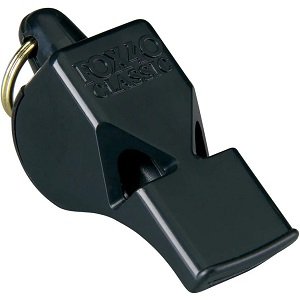
1. Fox 40 Classic Whistle for Hiking
Tech Specs:
- Material: High-impact ABS plastic
- Sound Output: 115 dB
- Design: 3-chamber pealess design
- Dimensions: 2″ x 1″ x 1″
- Weight: Approximately 0.9 oz (25g)
- Features: Self-clearing chambers, no moving parts
Fox 40 Classic Whistle is a staple in the world of safety and emergency signaling. Its pealess design ensures that there are no moving parts to jam or freeze. The 3-chamber design produces a high-pitched sound that can be heard over a mile away.
One of the notable features is its self-clearing chambers, so even if the whistle gets submerged in water, it will clear itself upon the next blow. This is particularly useful for activities like kayaking or during unexpected rainstorms.
In our experience, the Fox 40 Classic is easy to blow and produces a consistent sound without requiring excessive effort. Its compact size allows it to be attached to a keychain, backpack, or life jacket without adding significant weight.
Pros: | Cons: |
| Reliable pealess design | No built-in clip or lanyard |
| Loud sound audible over a mile | Limited color options |
| Self-clearing chambers for wet conditions | |
| Compact and lightweight | |
| No moving parts to jam or freeze |
2. Storm Safety Whistle for Hiking

Tech Specs:
- Material: Durable plastic
- Sound Output: Up to 130 dB
- Dimensions: 3.25″ L x 1.75″ W x 0.88″ T
- Weight: Approximately 1.1 oz (31g)
- Features: Operates underwater, includes split ring
- Design: Patented harmonic chamber for focused sound
The Storm Safety Whistle is famous for its powerful sound output, making it one of the loudest whistles available. Its patented harmonic chamber focuses sound into a single 3150 hertz frequency, ensuring that the whistle cuts through ambient noise effectively.
A unique feature of the Storm Whistle is its ability to operate underwater, which is invaluable for activities like diving, kayaking, or during heavy rain. The included split ring allows for easy attachment to gear or clothing.
In our testing, the Storm Whistle required minimal effort to produce a loud, piercing sound. Its robust construction feels durable, and the color enhances visibility.
Pros: | Cons: |
| Extremely loud, up to 130 dB | Bulkier than other models |
| Operates underwater | Too loud for close-range use |
| Durable construction | |
| Easy to blow with minimal effort | |
| Includes split ring for easy attachment |
3. HyperWhistle World’s Loudest Whistle

Tech Specs:
- Material: Durable plastic
- Sound Output: Up to 142 dB
- Weight: Approximately 1.5 oz (43g)
- Features: Includes reusable hearing protectors, lanyard
- Design: Radial tri-frequency design for maximum sound
- Range: Audible up to 2 miles
The HyperWhistle is the loudest mouth-blown whistle for hiking available, reaching an astonishing 142 dB. Its unique radial tri-frequency design ensures that the sound carries over long distances, making it ideal for emergency situations where being heard is critical.
This whistle includes reusable hearing protectors and a lanyard, acknowledging its powerful sound output. It’s designed to work in all weather, including underwater.
In our experience, the HyperWhistle emergency hiking whistle is incredibly loud, and it’s advisable to use the included hearing protectors during extended use. Its construction feels solid, and the included lanyard allows for convenient carrying.
Pros: | Cons: |
| Unmatched loudness at 142 dB | Requires hearing protection because of loudness |
| Audible up to 2 miles | Larger sizes don’t suit all users |
| Includes hearing protectors and lanyard | |
| Operates in all weather conditions | |
| Durable construction |
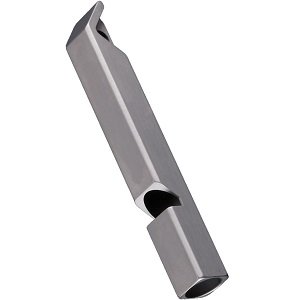
4. Nitecore NWS10 Emergency Whistle
Tech Specs:
- Material: TC4 titanium alloy
- Sound Output: 120 dB
- Weight: Approximately 0.2 oz (5.7g)
- Dimensions: Approximately 2″ in length
- Features: Single-chamber design, corrosion-resistant
- Design: Uni-body construction for durability
The Nitecore NWS10 is a compact and lightweight emergency whistle crafted from TC4 titanium alloy, offering excellent durability and corrosion resistance. Its single-chamber design emits a high-pitched frequency that can be heard over long distances.
The uni-body construction ensures there are no moving parts. This will reduce the risk of failure in critical situations. Its compact size and lightweight nature make it an excellent addition to any hiker’s gear without adding noticeable weight.
In our testing, the NWS10 produced a sharp, clear sound with minimal effort. Its sleek design and titanium construction make it both functional and aesthetically pleasing.
Pros: | Cons: |
| Lightweight and compact | Higher price |
| Durable TC4 titanium alloy construction | No included lanyard or clip |
| Corrosion-resistant | Limited color options |
| High-pitched sounds for long distances | |
| Uni-body design |
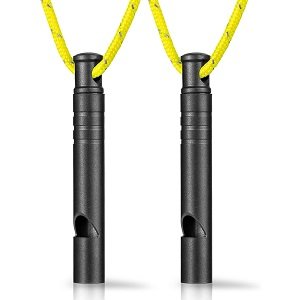
5. TISUR Titanium Emergency Whistle
Tech Specs:
- Material: Titanium alloy
- Sound Output: 120 dB
- Weight: Approximately 0.2 oz (6.7g)
- Dimensions: 2.02″ L x 0.28″ W
- Features: Includes lanyard, corrosion-resistant
- Design: Sleek, minimalist design
TISUR Titanium Emergency Whistle combines durability with a sleek design. It’s corrosion resistant and lightweight, making it suitable for various outdoor conditions. The whistle produces a loud 120 dB sound.
Its compact size allows it to be worn as a necklace or attached to gear without being obtrusive. The included lanyard adds convenience, and the minimalist design appeals to those who prefer understated gear.
In our background, the TISUR whistle is easy to blow and produces a consistent, loud sound. Its titanium construction feels sturdy, and the overall design is functional and stylish.
Pros: | Cons: |
| Lightweight and compact | It’s too small for some users |
| Durable titanium construction | No built-in clip |
| Corrosion-resistant | |
| Includes lanyard for easy carrying | |
| Sleek and minimalist design |
6. Coghlan’s Four Function Whistle

Tech Specs:
- Material: Plastic
- Sound Output: Approximately 100 dB
- Dimensions: 6.95″ x 3.95″ x 1″
- Weight: Approx. 1.3 oz (37g)
- Features: Built-in thermometer, compass, magnifier, and whistle
- Design: Multi-tool with attached lanyard
Coghlan’s Four Function Whistle is ideal for hikers and campers who love multipurpose gear. This whistle integrates four survival tools into one compact unit: a whistle, a small compass, a thermometer, and a magnifying glass. Although its whistle isn’t the loudest on this list, the added utility makes it a popular choice among ultralight backpackers and day hikers.
The built-in compass is useful for quick directional checks, while the thermometer helps you monitor ambient conditions during changing weather. The magnifying glass, though small, can assist with reading maps or even fire-starting in bright sunlight.
This model is lightweight and convenient. It’s more of a general-purpose hiking gadget than a professional-grade emergency whistle, but it’s great for kids, scouts, or backup use.
Pros: | Cons: |
| Multifunctional tool | Lower sound output compared to others |
| Budget-friendly and great for beginners | Plastic build feels a bit cheap |
| Comes with a lanyard | Not ideal as a primary survival whistle |
| Lightweight and easy to carry | |
| Fun and educational for kids |
7. Vargo Titanium Emergency Whistle

Tech Specs:
- Material: Titanium
- Sound Output: 100+ dB
- Weight: 0.1 oz (2.8 grams)
- Dimensions: 2.2 inches (56 mm) length; 0.3 inches (8 mm) diameter
- Design: Pealess, uni-body construction
- Included Accessories: 30-inch reflective lanyard
The Vargo Titanium Emergency Whistle is a top-tier choice for hikers and outdoor lovers prioritizing minimal weight. Crafted from titanium, this whistle boasts exceptional strength and corrosion resistance. Its robust construction ensures longevity, and the loud, piercing sound provides peace of mind during outdoor excursions.
Its pealess design eliminates moving parts. This will reduce the risk of mechanical failure in critical situations. The whistle produces a sharp, high-pitched sound exceeding 100 decibels, effectively cutting through ambient noise to signal for help when needed.
Weighing a mere 0.1 ounces, the Vargo whistle is virtually unnoticeable when carried, making it an excellent addition to any emergency kit or backpack. The included 30-inch reflective lanyard enhances visibility and accessibility.
Pros: | Cons: |
| Ultralight at 0.1 oz (2.8 grams) | Requires strong breath for high volume |
| Durable titanium construction | No built-in clip for attachment |
| Pealess design reduces mechanical failure | |
| Loud, high-pitched sound exceeding 100 dB | |
| Includes reflective lanyard |
1. Why You Need an Emergency Whistle for Hiking
An emergency whistle is a small but essential safety tool for every hiker. It can signal for help if you get lost, alert others during wildlife encounters, or guide search-and-rescue teams to your location. A loud, reliable whistle increases your chances of being found quickly, making it a must-have in every hiking kit. Include one that is lightweight and durable to avoid adding unnecessary weight to your backpack.
2. How Loud Should a Hiking Whistle Be? (Decibel Guide)
The loudness of a whistle is measured in decibels (dB). Most hiking whistles range from 115 dB to 142 dB, which can carry your signal up to a mile in open terrain. Pealess whistles tend to maintain consistent loudness in all weather conditions. For safety, aim for a whistle above 120 dB—enough to be heard over wind or running water.
3. Pealess vs Pea Whistles: Which Is Better for Hiking?
Pealess whistles produce a sharp, consistent tone without moving parts, making them more durable and reliable in cold or wet conditions. Pea whistles have a small ball inside that creates a trill but can freeze or jam. For hiking and survival situations, pealess whistles are preferred, while pea whistles can still be suitable for casual day trips.
4. Lightweight Emergency Whistles for Backpacking
When backpacking, every gram counts. Titanium and aluminum whistles weigh under 15 grams, making them ideal for ultralight kits. Plastic whistles are also lightweight but may not be as durable. Choosing a compact, high-decibel whistle ensures you’re prepared without adding bulk to your gear.
5. How to Choose the Best Survival Whistle
Here’s a comprehensive guide to help you make the best choice for your needs.
Sound Level (Decibel Rating)
The most important feature of any emergency whistle is how loud it is. Look for a whistle that produces at least 100 dB. This ensures the sound will cut through wind, rain, and forest noise to alert rescuers or nearby hikers.
Pealess vs. Pea Whistles
Pealess designs are more reliable for outdoor use. They’re less likely to freeze, jam, or get clogged with dirt and moisture. Pea whistles may be fine for dry environments, but they’re not ideal for rugged trail use.
Material
- Titanium & Aluminum: Lightweight, rust-resistant, and durable. Great for ultralight hikers.
- Plastic: Affordable and often louder than expected. Many plastic models float, which is great for kayaking or wet hiking environments.
- Stainless Steel: Strong and durable, but can be slightly heavier.
Weight and Portability
Backpackers and minimalist hikers should prioritize ultralight models like the Vargo Titanium. But even larger plastic models are usually light enough to carry on a lanyard or keychain.
Extra Features
Some emergency whistles come with built-in compasses, thermometers, or signal mirrors. While not mandatory, these can be useful if you want a multi-functional survival tool.
Ease of Use
A whistle should be easy to blow, even when you’re cold, tired, or injured. Test the mouthpiece and airflow design when possible.
Visibility
High-visibility colors like orange or neon green make the whistle easier to find in low light or after a drop. Reflective lanyards also help.
Water Resistance
Hiking often means wet conditions. Make sure your whistle works even when wet or submerged—most quality pealess designs do.
Conclusion
Out in the backcountry, a whistle isn’t just a piece of plastic or titanium—it’s a voice when yours can’t be heard. Each of the seven emergency whistles for hiking we reviewed offers something different—from featherlight titanium builds for ounce-counters to multipurpose tools for those who want added survival features. We’ve tested these in rain, on ridgelines, and through the thick of pine and brush. And if there’s one thing we’ve learned: loud, tough, and easy to reach is non-negotiable.
Choose the model that fits your hiking style and don’t wait for an emergency to realize how much a small tool can matter. Tuck it on your shoulder strap, wear it around your neck, or clip it to your pack—just make sure it’s with you!
FAQs About Hiking Safety Whistles
It’s best to keep your whistle in an accessible place—around your neck on a lanyard, attached to your backpack strap, or clipped to a chest pocket. The point is to reach it without removing your backpack.
Although possible, it’s not recommended. Sports whistles often have pea designs and aren’t built to handle outdoor weather like rain, snow, or mud. Emergency whistles are generally pealess and more reliable.
Yes. Besides emergencies, hikers use whistles to communicate with group members when visibility is low or terrain is rough. Three short blasts is a common distress signal.
Absolutely. Electronics can fail because of battery loss, signal issues, or damage. Whistles don’t require power and work instantly. They’re an essential backup, not a replacement.
Some parks and organized group hikes do recommend or even require a whistle as part of your safety kit, especially in remote or mountainous areas.