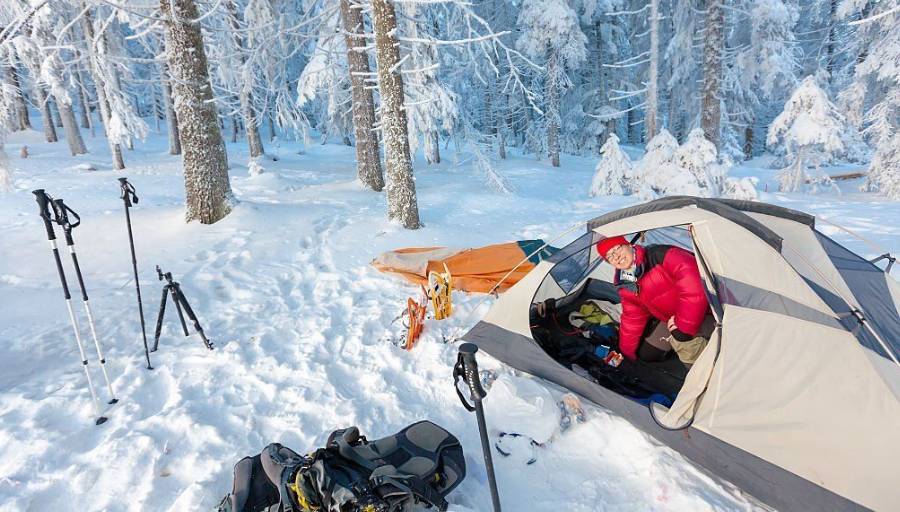
How to Stay Safe in a Thunderstorm While Hiking

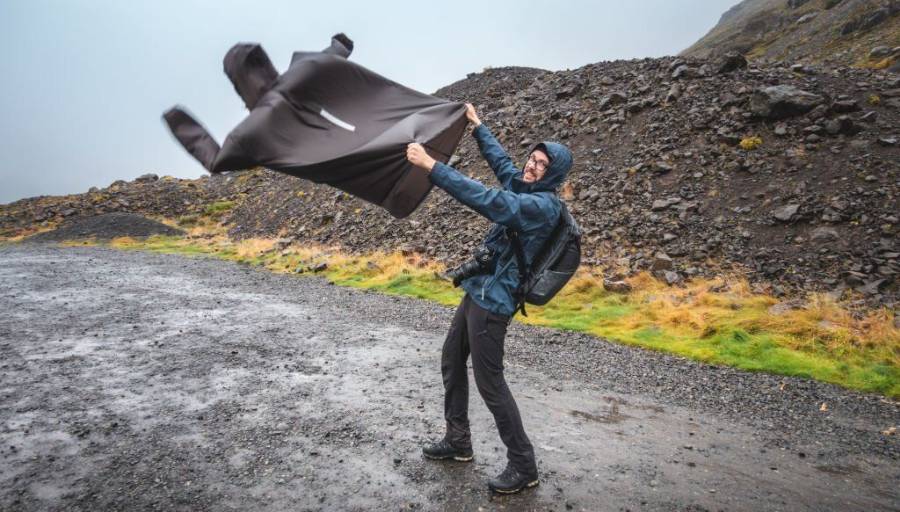
Thunderstorms can turn a safe hike into a dangerous situation in minutes. Lightning, strong winds, heavy rain, hail, and flash flooding can threaten hikers, especially on exposed ridges, mountain summits, and open trails.
The safest way to handle a thunderstorm while hiking is to check the forecast before departure, turn back or seek shelter early, and get inside a substantial enclosed building or hard-topped vehicle as soon as you hear thunder. If no safe shelter is available, you can reduce some risks by moving away from exposed high ground, isolated trees, and water, but no outdoor location is completely safe from lightning.
In this guide, you’ll learn how to recognize developing thunderstorms, plan your hike around weather risks, identify safer shelter options, and respond if a storm catches you on the trail.
Building strong trail awareness and decision-making skills can also help you respond more confidently when weather conditions change. Explore advanced hiking skills and techniques to improve your terrain awareness, route planning, and outdoor judgment.
Storm When Hiking: Risky Weather Situation
To enhance comprehension and ensure effective protection, let’s understand thunderstorms, their nature, and associated risks.
What is a Thunderstorm?
A thunderstorm develops when warm, moist air rises into a cooler atmosphere, forming a cumulonimbus cloud. Individual thunderstorms often last around 30 minutes, although storms can persist longer when new cells develop or a storm system remains over an area. Thunderstorms can produce lightning, heavy rain, hail, and strong winds.
To form, a thunderstorm needs two things: a mass of warm air near the ground and a mass of cold air at high altitude. Within these air masses, the atmospheric pressure is different, which favors air flows between the two masses. They mix and form a cloud called cumulonimbus, which strongly resembles the chimneys of nuclear power plants!
Inside this cloud, warm air will rise, and cold air will sink. These atmospheric currents, which carry the electrical charges that compose them with them, are the lightning creation factors. The storm is born! When the air humidity is high, the water present at high altitudes will tend to come down in the form of drops of water, this is rain.
Explore the Hazards Posed by the Storm
The storm promotes the development of several risks:
- Lightning: Thunderstorms produce electrical discharges that can strike the ground, nearby objects, or people. Lightning can cause cardiac arrest, severe burns, neurological injuries, and death. A strike does not need to hit a person directly to cause injury, as electrical current can spread through the ground. Seek a substantial enclosed building or hard-topped vehicle as soon as you hear thunder.
- Violent wind: as we have seen, hot and cold air currents favor the creation of a vortex within the storm itself. This creates gusts of wind that sometimes exceed 100 km/h in a storm. Also note that tornadoes are stormy winds that manage to touch the ground.
- Rain/hail: the hourly rainfall can be extreme during a storm, which favors the flooding of rivers and mountain torrents.
1st Reflex: Know How to Anticipate the Storm
The first attitude to adopt when the weather is stormy is to anticipate its formation through observation. Like me, you’re not a meteorologist, but a few easy-to-remember tips can help you get there without too much difficulty.
Weather Favorable for the Creation of Thunderstorms
First of all, look at the weather report of the day! Meteorologists indicate when the weather is thunderstorm near your home and from what time. If you see that the day will be stormy and at risk, don’t hesitate to delay your departure by one day.
Also remember that in summer, thunderstorms tend to form in the late afternoon when the air is warmest, and the ground gives off the most heat. The air at the altitude cooled, and the storm broke around 6 p.m. This is why leaving early in the morning will prevent you from finding yourself in a thunderstorm at the end of the day.
You will already have arrived at your next stop by mid-afternoon! Once again, preparing for the hike before departure will allow you to reduce the risks. Packing suitable snacks is another part of hike preparation, particularly when delays or route changes extend your time on the trail. See our guide to the best energy bars for hiking for convenient options to carry in your pack.
Recognize a Cumulonimbus
Now you know the favorable weather for the formation of a thunderstorm. It’s time to look at how to recognize them before they even form! For this, remember that several steps are necessary for its formation:
- Humidity turns into cumulus-type clouds
- The cumulus clouds are gathering, and the sky is darkening.
- The cumulus mingle to form a single cumulonimbus; the storm bursts.

Cumulus clouds (also called heat clouds) are the most common clouds. They are recognizable by their cotton shape! The advantage of knowing how to recognize them is that a storm could not form without their presence beforehand.
But be careful, it is not because you will see cumulus clouds that a storm will necessarily form! If the sky is clear when leaving in the morning, many cumulus clouds form in the middle of the afternoon. Then be vigilant, it may be a warning sign of a thunderstorm.
After a few hours, the cumulus present in the sky will come together to form a single gigantic cloud: the cumulonimbus (if the trend is stormy). It is recognizable by its typical mushroom shape, as in the figure 1 above. If you see this type of cloud several tens of kilometers in front of you, you will know that there is a thunderstorm just below!
Try to Predict Its Direction
Knowing how to identify a thunderstorm in the middle of your hike is great, but you need to use this knowledge to protect yourself from it. The first thing to do is not panic. By keeping your cool, you’ll avoid the most common hiking injuries: strains, sprains and falls.
Did you know falls kill more people every year than storms? So now you are calm and able to spot a thunderstorm, you will have to try to predict its direction. For this, there is no need to check where the wind is coming from. Because in a storm, these are swirling! To predict its direction, take a few moments to observe it while taking a fixed landmark in the landscape: church steeple, mountain, etc.
Observing a storm’s movement can help you understand changing weather conditions, but it cannot guarantee that you are safe. Thunderstorms can change direction, and lightning can strike well away from the main storm. If you hear thunder, do not wait ten minutes to assess its movement; seek proper shelter immediately.
On the other hand, if it comes toward you, you have two options: retrace your steps if you haven’t left for a very long time or find shelter before he joins you. For longer routes, planning your timing, turnaround points, supplies, and backup options before leaving can help you respond more effectively when conditions change. Read our guide on how to prepare for a long hike for a more detailed planning checklist.
Storm Above My Head: What to Do?
Sometimes, the lack of visibility or the speed of the formation of the storm does not give us time to see it coming. This is not inevitable. However, there are several ways to protect yourself from the risks induced by the storm.
To Shelter
Taking shelter is a necessity when you are under a storm. Depending on the landscape in which you are hiking, here are several possibilities of shelters likely to protect you against the storm:
- Valley bottoms: it is well known that lightning travels as short as possible and therefore strikes the highest points in altitude. If you are in the mountains, don’t stay at the top and take shelter at the bottom of the valley. In summary, descend as much as possible in altitude!
- Mountain shelters: A substantial, fully enclosed building can provide protection from lightning. Prefer a properly enclosed shelter rather than an open-sided shelter or an exposed structure. Do not assume that every mountain hut is lightning-safe simply because it has a roof or lightning rod.
- Enclosed buildings: A substantial, fully enclosed building is generally a safer place during a thunderstorm than an exposed outdoor location. Churches and other buildings may provide protection, but do not assume that every building has a lightning rod or an adequate lightning protection system. Once inside, stay away from windows and avoid plumbing and electrical equipment during the storm.
- Caves and rock overhangs: Do not treat a cave entrance or rocky overhang as a safe substitute for a substantial enclosed building. Lightning current can travel through rock and the ground, and heavy rain can trigger rockfalls, landslides, or flash flooding. Prioritize a proper enclosed shelter and avoid exposed cave entrances and unstable slopes.
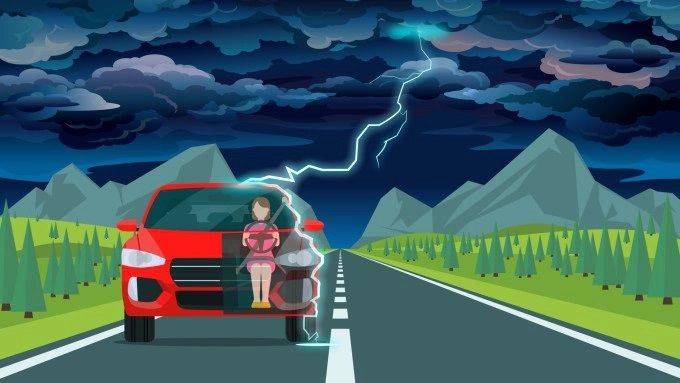
- The car: a fully enclosed car, excluding convertible models, functions as a Faraday cage. In other words, it provides protection against lightning. If lightning were to strike the vehicle, its body would deflect the electricity to the ground, preventing any impact on the occupants.
Avoid Risky Places
In a storm, because of the sound of thunder and the violent rain that falls on you, you will want to take shelter wherever you think possible. But several places increase the risk in the event of a storm instead of protecting you from it! Here are which ones and why they should be avoided:
- Forests and trees alone: although trees can protect us from the rain thanks to their leaves, it is important not to take shelter under them in the event of a storm. In the case of a single tree, lightning will be attracted to this higher point than the rest of the meadow or clearing. Under it, the risk of electrification is very markedly increased. Forests protect against the risk of lightning strikes, thanks to the uniform vegetation cover. But it’s not just lightning that poses a danger during a storm, there’s also the wind! Falls of branches are very numerous when the storm rages, and it is important to avoid staying under the trees from which they fall.
- The clearings/the plain: in a landscape where nothing goes beyond, you become the highest point, which will irremediably attract lightning when it strikes the ground. Avoid the clearings!
- Ridges/summits: it’s the same principle as before, except that the mountain peak on which you walk already represents a high point. We have seen it, but you must descend as much as possible in altitude in the event of a storm.
- The rock walls: because of the torrential rains and the lightning that can strike the summits, landslides are frequent during a storm. If you stay close to the walls, you risk being buried.
- Precipices: because of the wind, fear and precipitation, the risk of a fatal fall is multiplied. You must therefore avoid risk areas such as ravines and precipices.
- Electric poles and networks: lightning often strikes electric poles, transformers or high-voltage lines, so get as far away as possible.
- Watercourses: Move away from rivers, streams, lakes, and other bodies of water during a thunderstorm. Water and wet ground can carry electrical current, while heavy rainfall can cause sudden flash flooding. Never attempt to cross a swollen stream or flooded trail. Move toward higher, safer ground if flooding threatens, while avoiding exposed ridges and summits during the lightning threat.
Lightning Strikes Nearby: What Should Hikers Do?
If you see lightning or hear thunder while hiking, seek a substantial enclosed building or hard-topped vehicle immediately. Do not wait for rain or for the storm to move overhead. If proper shelter is unavailable, reduce your exposure to lightning and other hazards while moving toward safer terrain.
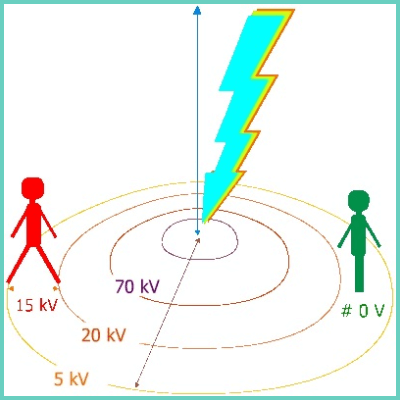
If safe shelter is not immediately accessible:
- Move away from mountain summits, ridges, exposed slopes, and open areas.
- Stay away from isolated trees, metal fences, power lines, and bodies of water.
- Avoid rocky overhangs and exposed cave entrances as shelter.
- If hiking with others, spread out rather than clustering together, while maintaining the ability to communicate and help after a strike.
- Never lie flat on the ground in an attempt to protect yourself from lightning.
These precautions may reduce certain risks, but they cannot make an exposed location safe. Continue toward proper shelter as soon as you can do so safely. For additional guidance, read the National Weather Service’s lightning safety recommendations.
What to Do When No Safe Shelter Is Nearby
In remote backcountry, you may not be able to reach a building or vehicle before a storm arrives. There is no outdoor position that guarantees protection from lightning, so focus on reducing exposure and avoiding additional hazards.
Choose your route carefully when proper shelter is out of reach. Avoid terrain exposed to falling rocks, unstable slopes, and flash flooding. Do not cross swollen streams or enter narrow ravines where runoff can rise quickly. Continue toward the safest available terrain without assuming that any outdoor location is protected from lightning.
Some backcountry guidance describes a low crouched position with the feet together as a last-resort risk-reduction measure. However, the National Weather Service no longer recommends relying on this position because it does not provide significant protection. Do not let it delay your attempt to reach safer terrain or proper shelter.
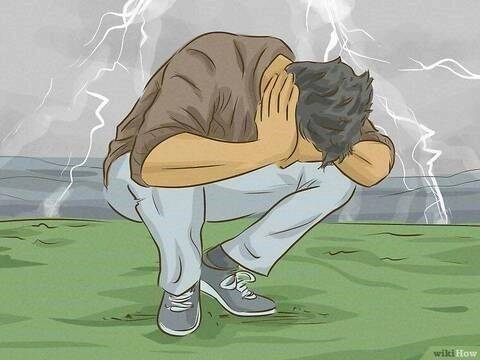
Once you reach a safe enclosed building or hard-topped vehicle, remain there for at least 30 minutes after the last thunder before resuming outdoor activities.
If someone is struck by lightning, call emergency services and begin CPR or use an AED if needed and available. Lightning victims do not retain an electrical charge, so it is safe to touch them while providing assistance.
Frequently Asked Questions About Thunderstorms While Hiking
How far away is a thunderstorm when you hear thunder?
You can estimate the approximate distance to a thunderstorm by counting the seconds between seeing a lightning flash and hearing its thunder. Divide the number of seconds by five to estimate the distance in miles, or by three to estimate the distance in kilometers. For example, a 9-second gap means the lightning was roughly 3 kilometers away.
However, this calculation does not tell you whether the storm is moving toward you, and lightning can strike far from the area of heaviest rainfall. If you hear thunder while hiking, treat it as a warning to seek proper shelter rather than relying on distance estimates to decide whether you are safe.
Is it safe to hike after a thunderstorm has passed?
Not necessarily. A storm can leave behind slippery rocks, muddy trails, fallen branches, damaged bridges, unstable slopes, and streams that rise quickly. Additional thunderstorms may also develop after the first storm passes.
Before continuing, check the latest weather forecast and any trail closures or local warnings. Inspect the route for obvious damage, avoid flooded crossings, and turn back if the trail becomes unstable or conditions remain uncertain. Wait at least 30 minutes after the last thunder before leaving a safe enclosed shelter.
Can a smartphone attract lightning while hiking?
No. A smartphone does not attract lightning simply because it is switched on or connected to a cellular network. The greater danger comes from being outdoors during a thunderstorm, particularly in exposed terrain.
Your phone can still be useful for receiving weather alerts, checking maps, and contacting emergency services. Keep it protected from rain and conserve battery power if you may need it for navigation or an emergency call. Do not remain in an exposed location to use your phone when you should be seeking shelter.
What should hikers do if a trail or bridge is flooded after a storm?
Never attempt to cross a flooded trail, bridge, or stream when the water’s depth, speed, or stability is uncertain. Even shallow, moving water can knock a person off balance, while floodwater may conceal holes, debris, or a damaged trail surface.
Stop at a safe distance and look for an official alternative route or wait for conditions to improve. Do not enter a narrow drainage channel or ravine to bypass the water. If the route cannot be crossed safely, turn back or contact the relevant park authority or emergency service for guidance.
Should hikers cancel a trip if thunderstorms are forecast?
Canceling or postponing is often the safest choice when severe thunderstorms are forecast along your route, especially if the hike involves exposed ridges, summits, remote terrain, or limited access to enclosed shelter.
For less severe forecasts, reassess the route, timing, available escape points, and the reliability of local weather information before deciding to go. Set a firm turnaround time and be willing to abandon the hike if conditions worsen. A summit or destination is never worth continuing into a dangerous storm.
What weather information should hikers check before a mountain hike?
Check the forecast for the specific trail area and elevation, not just the nearest town. Review thunderstorm probabilities, severe-weather alerts, wind speeds, rainfall forecasts, and any warnings about flash flooding. Mountain weather can differ significantly from conditions at lower elevations.
Check the forecast again shortly before departure and monitor updates during the hike when reception permits. In the United States, the National Weather Service provides official forecasts and alerts; elsewhere, use your national meteorological service or local mountain-weather authority.
Final Thoughts
Thunderstorms can develop quickly, making weather preparation an essential part of hiking safety. Check the forecast before departure, plan your route around potential weather hazards, and postpone your hike when severe thunderstorms are expected.
If you hear thunder, seek a substantial enclosed building or hard-topped vehicle as soon as possible. Avoid exposed ridges, isolated trees, unstable slopes, and areas vulnerable to flash flooding. If proper shelter is unavailable, understand that outdoor precautions cannot eliminate the risk of lightning.
By planning ahead, recognizing changing weather conditions, and responding promptly to thunderstorm warnings, you can make better decisions and reduce avoidable risks on the trail. For more advice, read our guide to camping in a thunderstorm.